


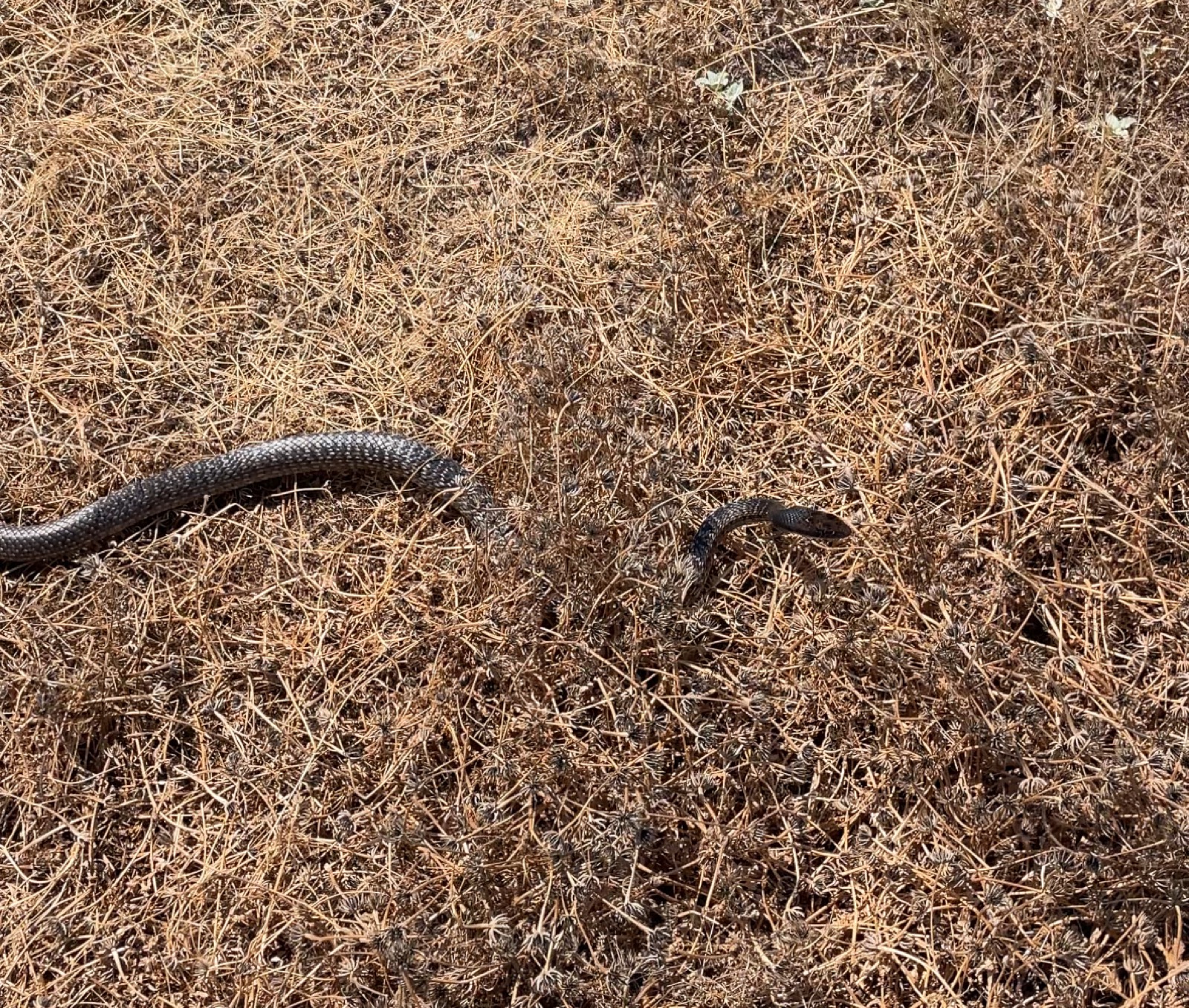
Why do snakes flick their tongues is a question rooted in a misunderstanding: many people read the flicking tongue as a sign of aggression or as the snake's 'stinger.' Neither is true. A flicking tongue is a snake doing the reptile equivalent of sniffing — gathering information about its surroundings. A snake that is calmly tongue-flicking is investigating, not threatening, and the tongue itself is completely harmless.
The mechanism is genuinely clever. As the tongue darts out, it picks up tiny airborne and ground-borne scent particles. When the tongue is drawn back in, those particles are delivered to the vomeronasal organ — also called Jacobson's organ — a pair of sensory pits in the roof of the mouth that detect chemical cues. The snake's brain interprets these signals much the way our brain interprets smells, giving the snake a detailed chemical picture of what is around it.
The famous forked shape is part of the design, not just decoration. Because the tongue has two tips that sample slightly different points in space, the snake can compare the strength of a scent on the left versus the right — a kind of stereo smelling. That difference lets a snake follow a scent trail with direction, which is how it tracks prey, finds mates, and detects predators even when it cannot see them clearly.
Snakes rely on this chemical sense heavily because their other senses are limited in ways ours are not. They have no external ears and hear airborne sound poorly, and many species have modest eyesight tuned mostly to movement. The tongue-and-Jacobson's-organ system fills that gap, and it is why a snake entering a new area or sensing a disturbance will flick its tongue more rapidly — it is collecting more samples, the same way you might sniff harder to place an unfamiliar smell.
Reading this correctly helps you stay calm during an encounter. A snake flicking its tongue at you is assessing whether you are food, threat, or irrelevant — and you are almost always filed under 'large, not food, avoid.' The behaviors that actually signal a defensive snake are different: tight coiling, holding ground, hissing, a gaping mouth, or rattling. Tongue-flicking on its own is a sign of a curious, investigating animal, and the right response is simply to give it space and let it move on.
Understanding how a snake senses the world does not tell you which species you are looking at, and that is the part that determines how cautious to be. If a snake is close enough to watch its tongue work, it is close enough to photograph from a safe distance — let SerpentID compare its visible markers against likely local species so you can decide whether you are watching a harmless rodent-hunter taste the air or a venomous species that deserves a wider berth.