


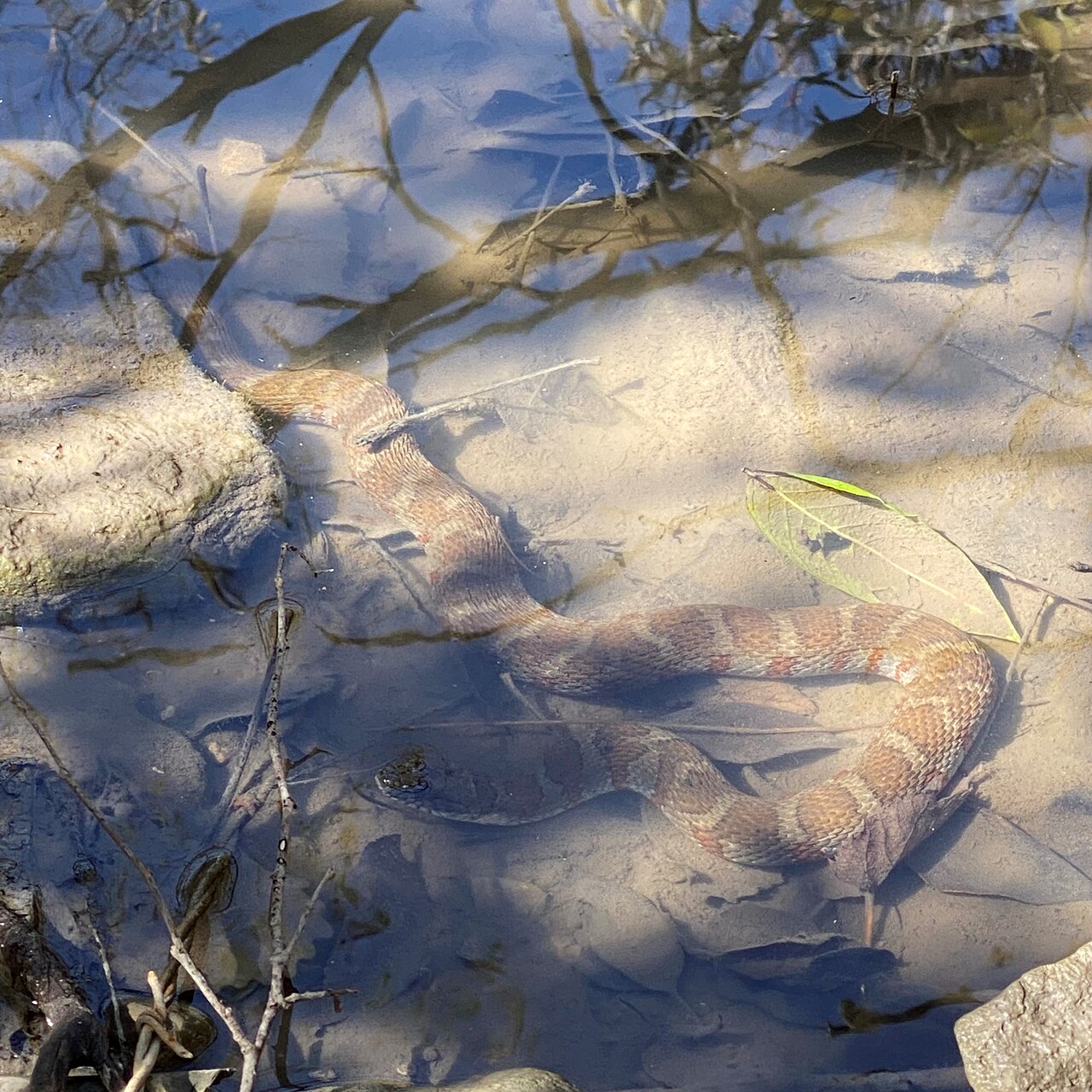
Can snakes swim is one of the most common questions people ask after spotting a snake crossing a pond or river, and the answer is yes — essentially every snake species can swim. Snakes move through water using the same lateral, S-shaped undulation they use on land, pushing against the water with the sides of the body. Some are clumsy and avoid deep water, while others are strong, confident swimmers that hunt fish, frogs, and tadpoles. The fact that a snake is in the water tells you very little about what species it is, so it is not a reliable danger signal on its own.
The detail people most often try to read is how the snake floats. There is a popular rule that venomous cottonmouths swim high with the whole body riding on top of the surface, while harmless water snakes swim low with only the head above water. It contains a grain of truth — cottonmouths do tend to float buoyantly — but it is not dependable. Harmless water snakes routinely swim with much of the body at the surface too, especially when moving quickly or basking-warm, and a cottonmouth crossing a current may ride lower than the rule predicts. Treat buoyancy as a weak hint, never as a verdict.
Geography is a far stronger filter than swimming posture. Cottonmouths (also called water moccasins) live only in the southeastern United States, in and around slow water, swamps, and wetland edges. Across most of North America, a snake swimming in a lake, stream, or backyard pond is almost certainly a non-venomous water snake (genus Nerodia) or another harmless species, simply because no cottonmouth lives in that range. Knowing whether cottonmouths even occur where you are removes most of the worry before you look at a single scale.
When you can see the animal clearly and safely, a few markers help. Water snakes have round pupils, a slender head only slightly wider than the neck, and a relatively even taper. Cottonmouths have a noticeably blocky, triangular head, a dark facial mask through the eye, vertical pupils, and a thick, heavy body. The behavior differs too: a cornered cottonmouth often holds its ground and gapes to show the white interior of its mouth — the display that gives the species its name — while a water snake usually flees, dropping off a log or diving when approached. None of these cues is worth getting close to confirm.
The bigger safety point is that you do not need to be in the water with a snake to be at risk of a bad decision. Most water-related bites happen when people try to grab, move, or kill a swimming snake, or when they step onto a submerged log or bank where a snake is resting. If a snake is swimming toward you, it is almost always heading for the bank or cover behind you, not attacking — move aside and give it a clear line, and it will keep going. Never reach into murky water, under docks, or into vegetation at the waterline where you cannot see.
If you swim, paddle, or fish in snake country, a few habits cut risk to near zero: stay out of dense aquatic vegetation and brush-choked banks, watch where you put hands and feet around logs and rocks, keep dogs leashed near wetland edges, and never handle a snake in or near water even if it looks dead. A snake in your pool is a separate situation — it is usually a harmless species that fell in and cannot climb out, and the safe move is to give it an exit ramp rather than to scoop it by hand.
When you genuinely need to know what is sharing the water with you, identify it instead of guessing from how it floats. SerpentID lets you photograph a snake from a safe distance — across the pond, from the dock, through a zoom — and compare it against common local species, so you can tell a harmless water snake from a cottonmouth on real markers and your region rather than on a swimming-posture myth. Identify first, then decide whether to simply give it space or to call a professional.