


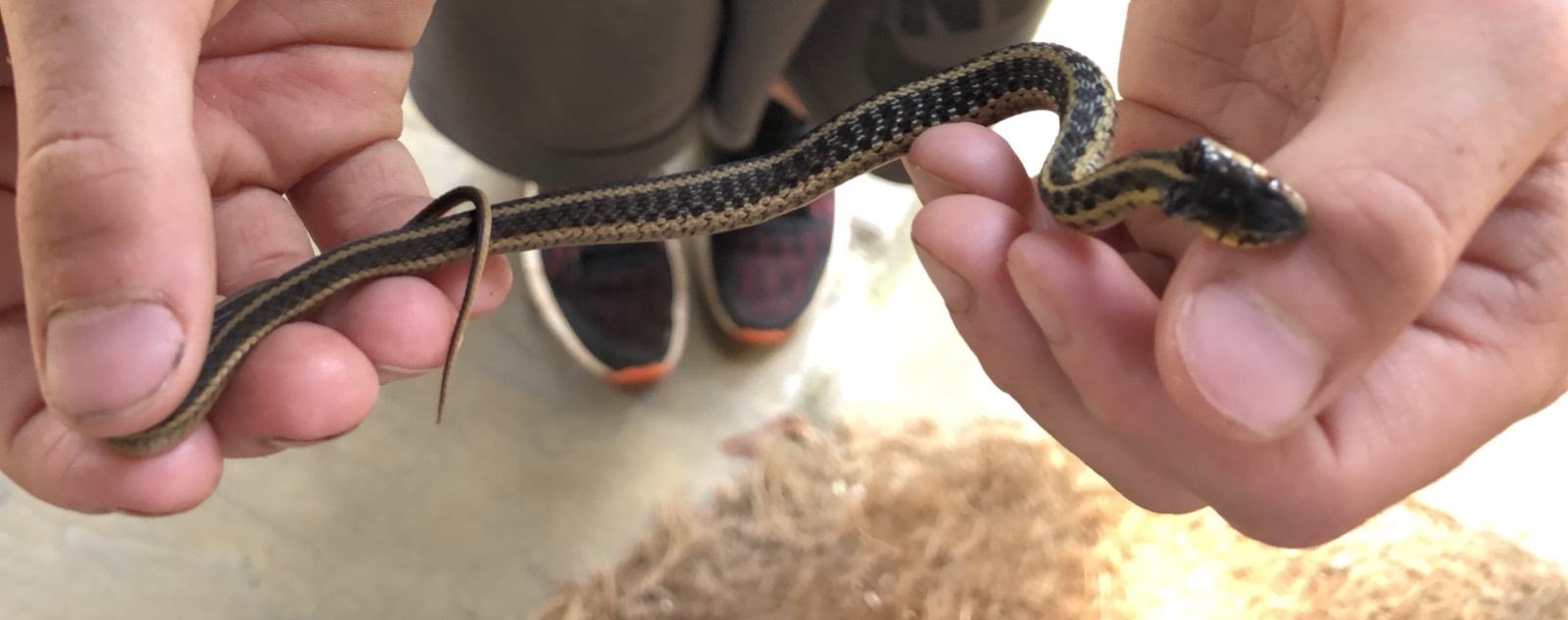
Few things make a gardener freeze faster than a thin, wriggling shape in freshly turned soil or under a potted plant. Is it an earthworm, or a baby snake? The question comes up constantly in the United States, Australia, and India, partly because several small, harmless snakes spend their lives underground and look remarkably wormlike. The good news is that a handful of reliable features separate the two, and nearly all of them can be checked by eye without touching anything.
Start with the surface of the body. An earthworm's skin is soft, moist, and often glistening with mucus, and it is divided along its length into many ring-shaped segments. Mature earthworms also have a clitellum, a smooth, slightly swollen band partway down the body that looks like a saddle or collar. A snake has no segments and no slime. Its body is covered in dry, overlapping scales that may look shiny or matte but never wet. Snakes are not slimy at all, a common misconception, and even very small ones have a crisp, polished texture compared with the rubbery look of a worm.
Next, look at the ends. An earthworm has no eyes, no jaws, and no clearly shaped head; both ends look broadly similar, and the front end is simply a tapering point. Most snakes have a defined head with a mouth and visible eyes, and they flick a forked tongue to sample the air. Movement is another strong clue. Earthworms crawl by stretching forward and then bunching up, so the body visibly lengthens and shortens. Snakes do not change length as they move; they travel in smooth side-to-side curves, and a startled snake often moves quickly and purposefully toward cover, while a worm tends to writhe in place.
The tricky exception is the blind snake. These small burrowing snakes are often pencil-lead thin, usually only a few inches long, uniformly dark brown, gray, or purplish, and shiny. Their eyes are reduced to tiny dark spots under the scales, the head and tail are both blunt and look almost identical, and many species have a minute spine at the tail tip that they press against surfaces. The Brahminy blind snake is the best-known example. It is native to South and Southeast Asia, very common in Indian gardens, and has spread around the world in the soil of potted plants, earning it the nickname flowerpot snake. It is now established in Florida and other warm parts of the southern United States and has turned up in parts of northern Australia, which also has dozens of its own native blind snake species. Unusually, Brahminy blind snakes are all female and reproduce without males, which helps a single snake in a plant pot start a new population.
Blind snakes are harmless. They have tiny mouths, are not venomous, and feed mainly on the eggs, larvae, and pupae of ants and termites. You can usually tell one from a worm by its lack of ring segments, its dry, uniformly scaled body with no saddle band, and the way it moves in quick, snakelike wiggles rather than stretching and contracting. In parts of India's Western Ghats and northeast, you may also hear about caecilians, legless amphibians that look like large worms with rings; these are not snakes either, and they are rarely encountered in ordinary gardens.
Here is the important caution. Not every small snake is a blind snake, and size tells you very little about danger. In the eastern United States, small harmless species like the worm snake, ring-necked snake, and Dekay's brown snake are common under leaves and logs, but newborn copperheads are also only around eight or nine inches long. In Australia, juvenile eastern brown snakes are small and can deliver a medically significant bite, and in India, young kraits and other venomous species can turn up in the same damp, sheltered places where worms gather. If something has scales, eyes, and a clearly shaped head, treat it as a snake you have not identified yet. Do not pick it up, poke it, or try to move it with your hand, and keep children and pets back. If anyone is bitten by any snake, seek professional medical help immediately.
When you are unsure, the safest move is to step back and take a clear photo from a comfortable distance, ideally showing the head, the body texture, and the tail. SerpentID can compare those markings against the species most likely to occur in your area, so you can tell whether you are looking at a harmless blind snake, a small yard snake, or something that deserves more respect. If the result suggests a venomous species, leave it alone and contact your local wildlife service or a licensed snake removal professional to handle it safely.