


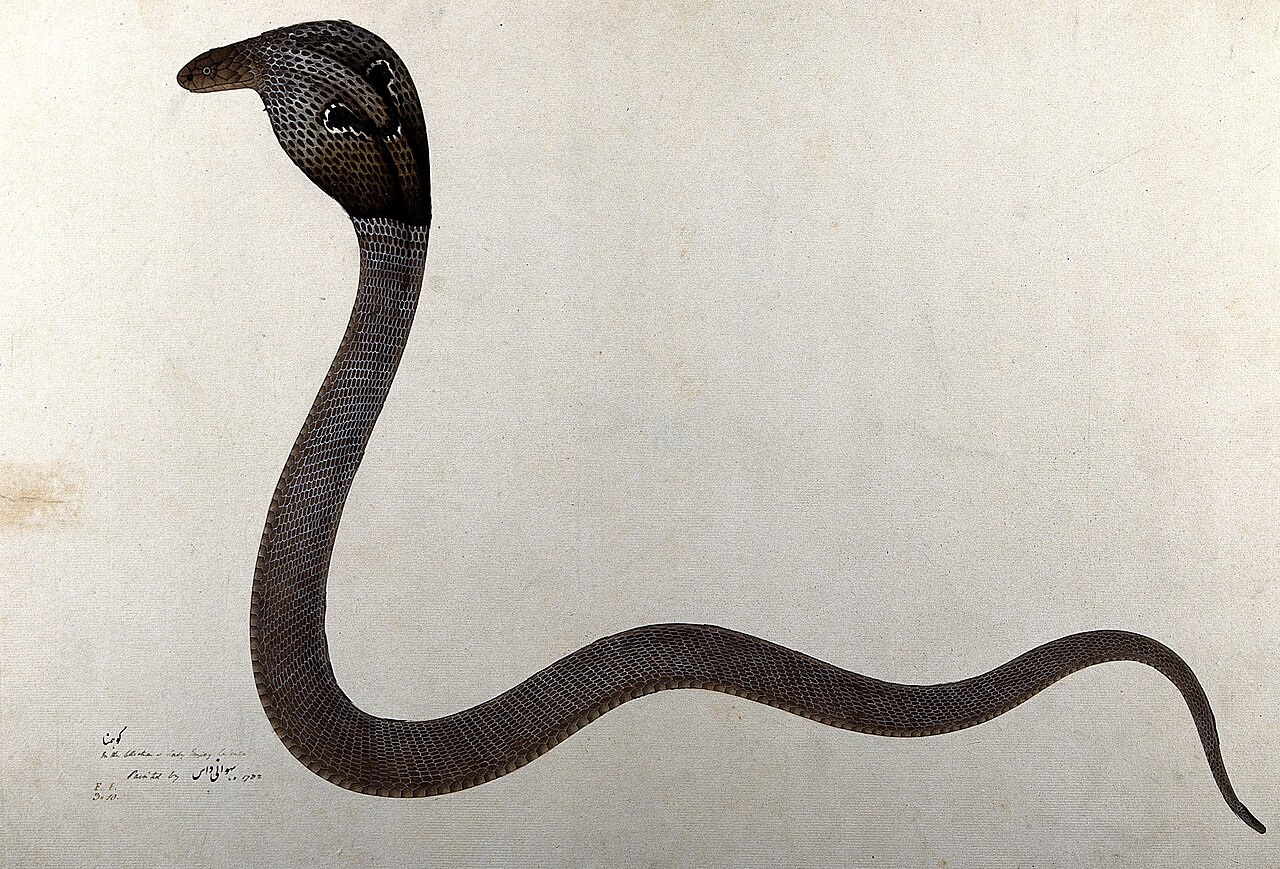
When people ask about the biggest snakes, they usually picture anacondas and pythons. Those are constrictors, though, not venomous snakes. Among venomous species, one stands clearly apart in length: the king cobra, Ophiophagus hannah. It lives across South and Southeast Asia, from India's Western Ghats and northeast through Myanmar, Thailand, Malaysia, Indonesia, and the Philippines. Adults commonly measure 3 to 4 meters (about 10 to 13 feet). The longest reliably measured individual was caught in Malaysia in the 1930s and grew to about 5.85 meters (roughly 19 feet) while kept at London Zoo. Claims of much longer wild king cobras turn up online and in local stories, but none have held up to verified measurement. Most king cobras people actually see are well under that record.
The king cobra is not a true cobra in the narrow sense. It belongs to its own genus, Ophiophagus, which means snake eater, and that describes its diet well. It feeds mainly on other snakes, including rat snakes, pythons, and sometimes other venomous species, and occasionally takes monitor lizards. A long, slender body helps it hunt prey that is itself long and slender. Researchers have also recently proposed splitting the king cobra into several distinct species based on genetic and physical differences, including a separate species in India's Western Ghats. Whatever the final classification, the longest venomous snake title stays within this group.
Like smaller cobras, a threatened king cobra can raise the front part of its body off the ground and spread a hood. Because the snake is so long, a raised king cobra can lift its head to about the height of an adult's waist or chest, which explains much of its fearsome reputation. Its venom is mainly neurotoxic, and a single bite can deliver a large amount of it, so a serious bite is a genuine medical emergency. In practice, though, king cobras are shy, tend to retreat when given the chance, and are responsible for relatively few bites. In India, most serious snakebites come from the Big Four: the spectacled cobra, common krait, Russell's viper, and saw-scaled viper. The king cobra is not one of them. Another unusual fact is that female king cobras are among the very few snakes known to build a nest. They gather leaf litter into a mound for their eggs and often stay near it for a period, and a guarding female should be given an especially wide berth.
The runners-up are worth knowing too. Africa's black mamba is the second-longest venomous snake. Adults typically reach 2 to 3 meters, and exceptional individuals have been reported at around 4 meters. Despite its name, it is usually olive to gray-brown; the name comes from the inky black inside of its mouth. Australia's coastal taipan commonly reaches about 2 meters, and occasional individuals grow close to 3. In Central and South America, the bushmaster is the longest viper in the world. It commonly reaches 2 to 2.5 meters, with rare individuals larger. Africa's Gaboon viper is far shorter but very heavy for its length, which sometimes causes confusion when people talk about the biggest venomous snakes.
It helps to separate length from danger, because they are not the same thing. A long snake is not automatically the most venomous, and a short one is not automatically safe. The inland taipan has the most toxic venom measured of any land snake, yet it is shorter than the king cobra. Many small snakes, such as kraits and saw-scaled vipers, cause serious harm out of all proportion to their size. Closer to home, the longest venomous snake in the United States is the eastern diamondback rattlesnake. Adults typically measure about 1 to 1.8 meters, and rare individuals exceed 2 meters. In Australia, the coastal taipan, mulga snake, and eastern brown snake are among the longest dangerous species. All of them call for the same response: keep your distance.
It is also worth debunking a few myths. King cobras do not chase people over long distances, they cannot spit venom like some smaller cobras, and they cannot stand fully upright on their tails. Size estimates are also very unreliable in the moment. Fear, distance, and a snake stretched along a branch or crossing a road can make a 2-meter snake look twice that long. That is one more reason not to judge danger by length. Never approach a large snake to get a better look, try to measure it, or try to move it along.
If you come across a long snake, whether it is a possible king cobra in India, a rattlesnake on a US trail, or a brown snake in an Australian backyard, stay back and give it a clear path to leave. Take a photo from a safe distance and let SerpentID compare its markings, head shape, and scale features against the species most likely in your area. If the app suggests the snake may be venomous, or you are unsure, contact your local wildlife service or a licensed snake catcher instead of handling it yourself. If anyone is bitten, seek professional medical help immediately.