


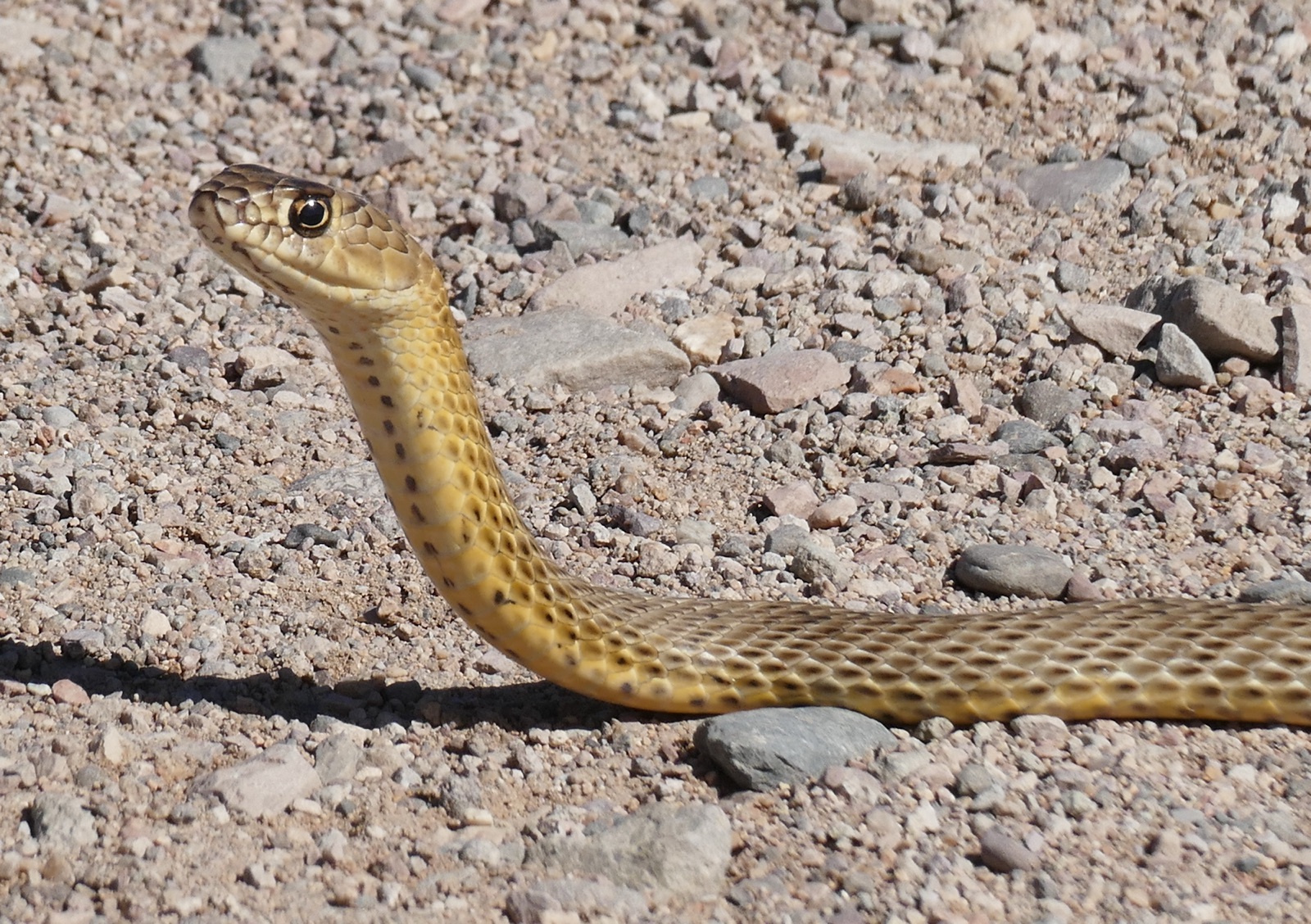
Ask almost anyone which snake is the fastest in the world and you will hear the same answer: the black mamba. That reputation is mostly earned. This long, slender elapid from the savannas and rocky hills of sub-Saharan Africa can cover ground very quickly in short bursts. It is often credited with speeds of about 15 to 20 kilometers per hour, or roughly 10 to 12 miles per hour. But the honest answer comes with a caveat. Very few snakes have been timed carefully in the wild, and many speed figures in books and online come from estimates or anecdotes rather than measured runs. Some of the most dramatic numbers, such as mambas outrunning galloping horses, are folklore. The safest summary is that the black mamba is among the fastest snakes known, and that no snake is as fast as the stories suggest.
To understand why some snakes are faster than others, look at body shape. The quickest species tend to be long, thin, and light for their length, with large eyes and an active, daytime hunting style. Black mambas, coachwhips, racers, whipsnakes, and many rat snakes all share this build. They are sometimes called active foragers because they search for prey by moving through open habitat rather than waiting in ambush. Heavy-bodied snakes such as most vipers, pythons, and boas are built very differently. They rely on camouflage and patience, and they move slowly across open ground. A rattlesnake or a puff adder is not designed to sprint. These snakes rely on staying still and unseen, and on their warning signals.
Fast snakes live on every inhabited continent where snakes occur. In the United States, the coachwhip and the North American racer are the classic speedsters. Both are nonvenomous, alert, daytime snakes that often bolt into cover the moment they notice a person. In Australia, the eastern brown snake and other brown snakes in the genus Pseudonaja are known for moving quickly when disturbed, and they are also dangerously venomous. In India, the Indian rat snake, or dhaman, is a fast, nonvenomous rodent hunter that often startles people near fields and homes. It is frequently mistaken for a cobra. Fast snakes elsewhere include the Oriental whipsnake and various African sand snakes. A snake's speed tells you nothing reliable about whether it is venomous. Fast harmless species and fast dangerous species can look surprisingly similar from a distance.
Temperature matters as much as species. Snakes are ectotherms, so their muscles work best when their bodies are warm. A racer basking on a sunny afternoon can move far faster than the same snake on a cool morning. That is one reason fast snakes are seen most often in warm, open places such as trails, field edges, roadsides, and lawns. Speed also depends on the ground. Snakes push off rocks, grass stems, and uneven soil, so they usually move faster through vegetation than across smooth pavement or loose sand. Sidewinding desert vipers are a partial exception, because their looping movement is built for shifting sand.
It also helps to separate travel speed from strike speed, because the two are often confused. Travel speed is how fast a snake moves across the ground, and for even the quickest species it is modest by human standards. A healthy adult jogging at an easy pace moves faster than almost any snake can sustain. Strike speed is different. It is the very rapid lunge of the head and front of the body, which can happen faster than a person can react. That is why the real danger of a snake encounter is getting within striking range, not being outrun. Most bites happen when someone steps on, reaches toward, or tries to handle a snake. They rarely happen during a pursuit.
Fast snakes have also produced one of the most persistent snake myths: that they chase people. When a racer or a mamba streaks toward you, it can feel like an attack. In most cases the snake is trying to reach its escape route, such as a burrow, a shrub, or a rock pile, and you happen to be standing between it and safety. Moving calmly to the side usually ends the encounter at once. Black mambas have a fearsome reputation, but they generally avoid people when given room. Most dangerous situations involve a cornered or handled snake. The best response to any fast-moving snake is the same: do not block its path, do not try to catch or kill it, and give it several body lengths of space so it can leave.
Because fast snakes are usually seen only for a moment, they are some of the hardest to identify, and that is where a careful photo helps. If a snake pauses, take a picture from a safe distance with your phone's zoom rather than stepping closer. SerpentID can then compare its body shape, color, pattern, and head features against the species most likely to occur where you are. Never follow, corner, or try to handle a snake to get a better look. If the app suggests a venomous species near your home, trail, or workplace, contact your local wildlife service or a licensed snake catcher. If anyone is bitten, seek professional medical help immediately.