


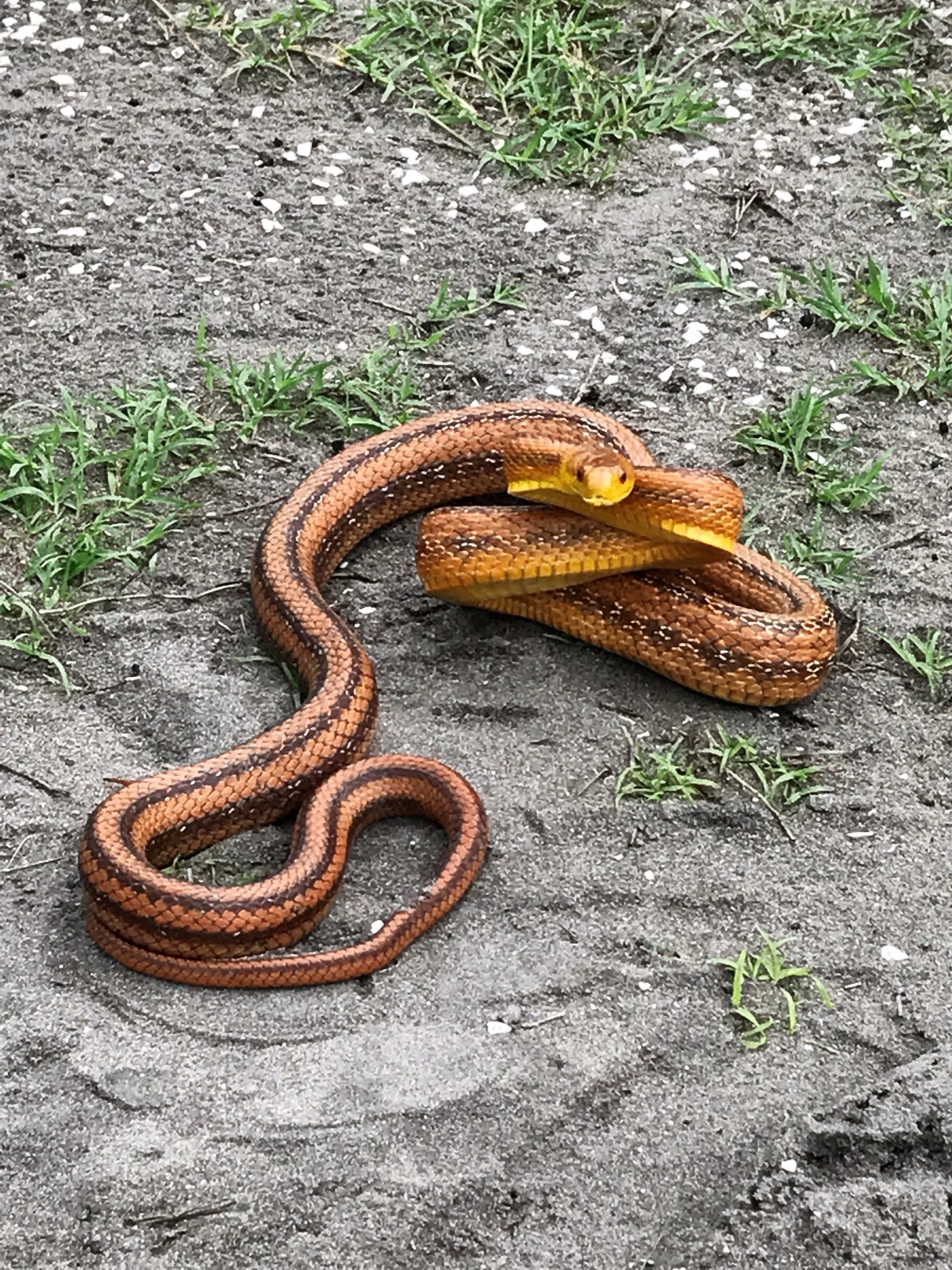
The hoop snake is one of the most enduring legends in North American snake folklore. In the classic version, a snake grabs the tip of its tail in its mouth, forms a stiff ring, and rolls down hills or across fields at great speed to chase a person. The story usually ends with the person jumping behind a tree just in time, the snake striking the trunk with a venomous stinger on its tail, and the tree swelling up and dying by morning. Versions of the tale were told in frontier tall-tale collections, around campfires, and on farms across the southern and midwestern United States, and some people still ask whether hoop snakes are real.
The short answer is no. No snake anywhere in the world has been documented traveling by biting its tail and rolling like a wheel. A snake's body simply is not built for it. Snakes move by pushing their scales and muscles against the ground, using lateral undulation, rectilinear crawling, concertina movement, or sidewinding. All of these depend on contact between the belly scales and the surface. A snake holding its own tail in its mouth would lose that grip entirely, would be unable to steer or brake, and would have no way to generate forward power on flat ground. Herpetologists have spent well over a century observing snakes in the field and in laboratories, and the rolling hoop has never turned up.
The venomous tail stinger is also pure myth. Snake venom is produced in glands in the head and delivered through the teeth or fangs. There is no snake with venom in its tail, and there is no snake whose tail can sting a person, a tree, or anything else. Trees do not swell or die from a snake strike, and the dramatic dead-tree ending was always the tall-tale flourish that made the story memorable rather than an observation anyone could verify.
So where did the legend come from? The most likely source is the mud snake, a large, glossy black-and-red species found in swamps and wetlands of the southeastern United States, and its close relative the rainbow snake. Both have a hard, pointed scale at the tip of the tail. When a mud snake is restrained, it may press that pointed tip against the hand holding it, which feels sharp and alarming but is completely harmless. The tip cannot pierce skin in any meaningful way and carries no venom. Mud snakes also tend to rest in loose loops and coils, and a glimpse of a coiled, shiny snake with a spiny tail could easily feed a story about rolling hoops and deadly stingers. Locally, the mud snake is still sometimes called the hoop snake or stinging snake for exactly this reason.
The ancient symbol of the ouroboros, a serpent eating its own tail, may also have helped the image feel familiar. That symbol appears in Egyptian, Greek, and Norse traditions as a sign of eternity and renewal, not as a description of real snake behavior. Many cultures, including in Australia and India, have their own stories of snakes with impossible abilities, from snakes that drink milk to snakes that take revenge. Like the hoop snake, these tales tend to say more about human fear and imagination than about the animals themselves, and they can lead people to misjudge which snakes actually deserve caution.
That matters because myths can push people toward the wrong reaction. A harmless mud snake or rat snake may be killed out of fear of a stinger that does not exist, while a genuinely venomous snake resting quietly in leaf litter may be overlooked because it does not match any dramatic story. The real safety rules are simpler than any legend: give every snake space, never try to handle, corner, or kill it, and keep children and pets back. If anyone is bitten by a snake of any kind, seek professional medical help immediately.
If you see a snake and are unsure what it is, the safest move is to stay where you are or step back, then photograph it from a safe distance. SerpentID can compare its color, pattern, and body shape against the species most likely to live in your area, so you can tell a harmless look-alike from a snake that needs real caution. If the snake turns out to be venomous or is in a place where people or pets will cross its path, contact your local wildlife services or a licensed snake removal professional rather than dealing with it yourself.