


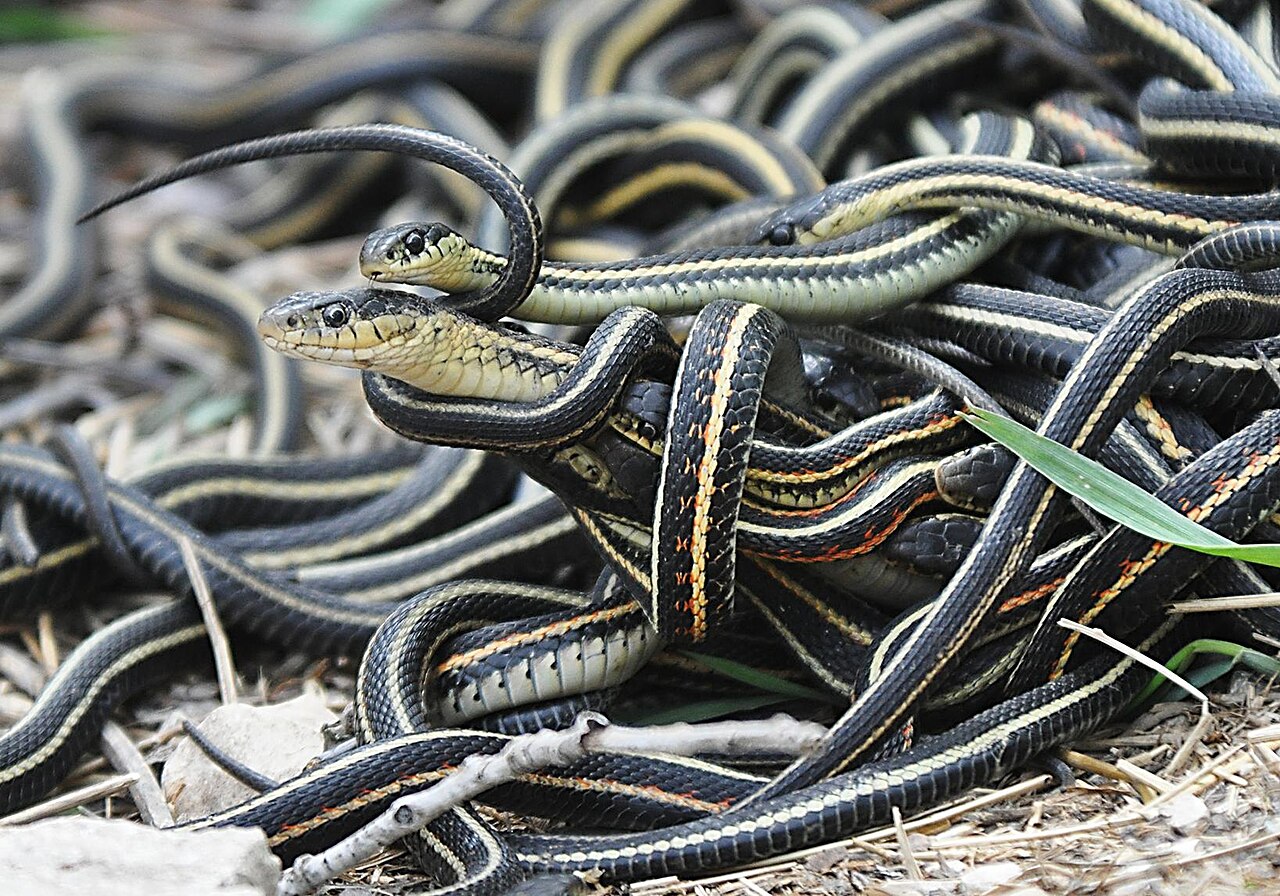
What is a group of snakes called comes up far more often than groups of snakes actually appear, because snakes are mostly solitary animals. When a collective noun is used, the common ones are a 'bed' of snakes or a 'nest' of snakes, and you will occasionally see playful terms like a 'knot' for a tangled cluster. None of these is a strict scientific label — they are everyday English words for the rare occasions when several snakes end up in the same place.
The most meaningful real-world term is a 'den,' also called a hibernaculum. This is a shared underground shelter — an old burrow, a rock crevice, or a deep cavity below the frost line — where snakes gather to wait out winter. In cold regions, many snakes, sometimes of more than one species, will use the same den year after year because suitable frost-free shelter is limited, and they return to it each autumn.
Snakes also bunch together for two other reasons worth knowing. The first is warmth: cold-blooded animals lose heat to their surroundings, and piling up reduces how much each individual loses, which is why you may find several sharing a sun-warmed rock or a sheltered nook. The second is breeding, when males may swarm a single female in a writhing 'mating ball' — a dramatic, temporary knot of snakes that disperses as soon as mating is over.
What a cluster of snakes almost never means is a cooperative family or a coordinated pack. Snakes do not hunt together, raise young together, or defend territory as a group the way social mammals do. Even at a den, they are essentially independent animals tolerating each other's presence because the shelter is good — the gathering is about the place, not about the company, and it breaks up once conditions change.
Finding several snakes in one spot is therefore a clue about the location, not a sign of an organized colony. A reliably warm, sheltered, prey-rich place — a rock pile, a compost heap, a sunny foundation gap — can draw snakes repeatedly, so if you keep seeing them in the same corner of a yard, the practical fix is to change what makes that corner attractive: clear cover, manage rodents, and seal gaps, rather than worrying about a 'nest' plotting against you.
And whether you find one snake or several, the question that matters for safety is still the species, not the headcount. Photograph any snake from a safe distance instead of approaching the cluster, and let SerpentID compare its markings against likely local species so you know whether you are looking at harmless animals using good shelter or something that warrants caution — and call local wildlife help if a venomous match turns up.