


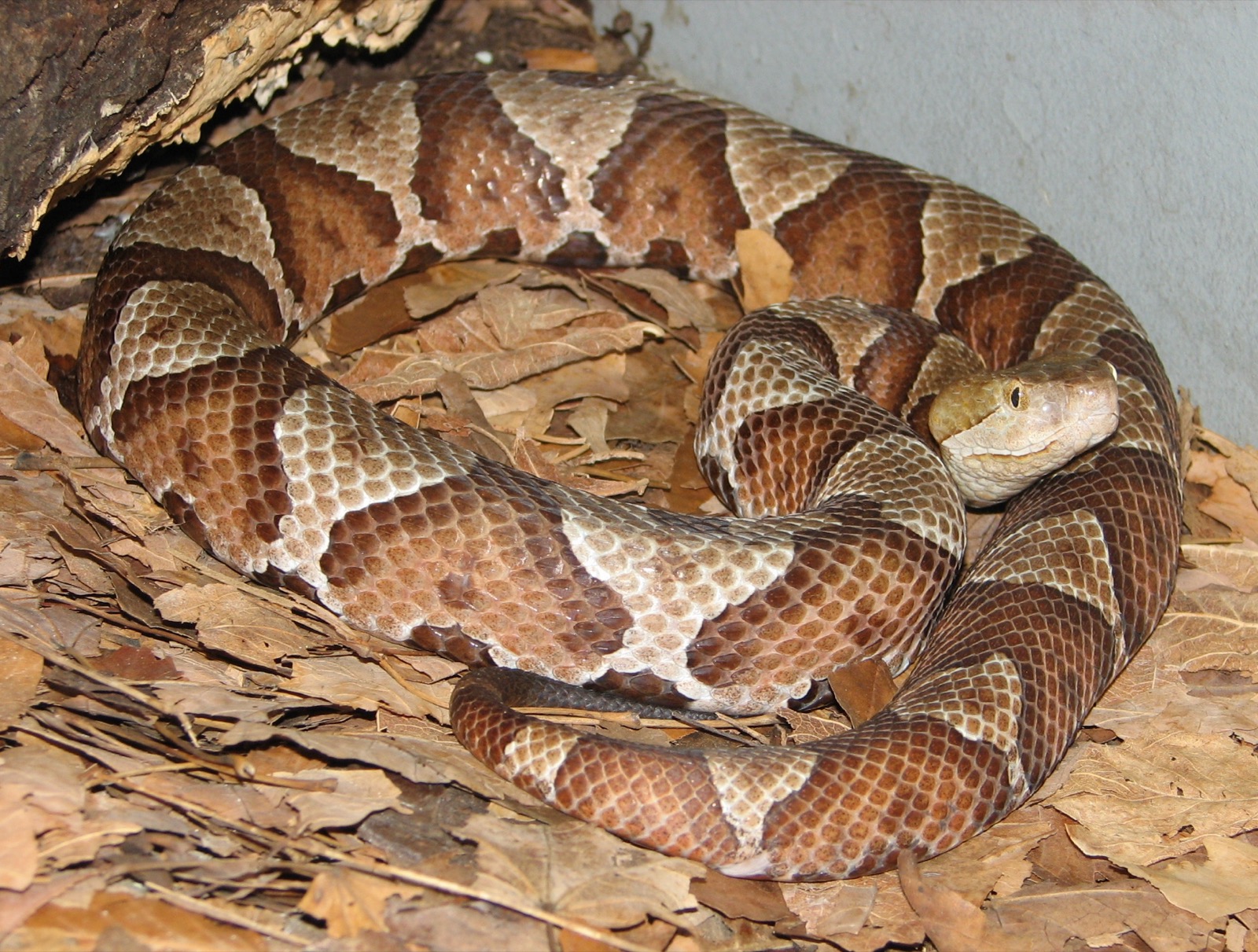
Copperheads are among the most commonly encountered venomous snakes in the eastern and central United States, and they are also among the most commonly misidentified. People mistake harmless snakes for copperheads every summer, and just as often walk right past a real one because it blends so well into leaf litter. Knowing what a copperhead actually looks like, and which features are reliable from a safe distance, helps you make a calmer and more accurate call. Note for readers in Australia: the snakes called copperheads there belong to a completely different group, the elapid genus Austrelaps, and look and behave differently. This guide covers the North American copperheads, Agkistrodon contortrix and the closely related broad-banded copperhead, Agkistrodon laticinctus.
The single most useful feature is the band shape. A copperhead's body is crossed by darker bands, usually chestnut, reddish brown, or dark tan, set against a lighter background that can be pale tan, pinkish, peach, or light gray-brown. Viewed from above or from the side, each band is wide at the bottom on the snake's flanks and pinches narrow along the spine, giving an hourglass shape. Many people describe the side view as looking like a row of chocolate kisses. Bands sometimes break at the midline or shift slightly so they look offset, but the overall wide-on-the-sides, narrow-on-the-back pattern holds up across most individuals. Many harmless look-alikes show the opposite: blotches or saddles that are widest across the back and taper down the sides.
The head is the source of the name. Adult copperheads usually have an unpatterned head in a coppery, rusty, or tan shade, often slightly brighter than the body, sometimes with a faint thin line along the side of the face. Like all pit vipers, they have a heat-sensing pit between the eye and the nostril and vertical, cat-like pupils, but these are details you should only ever see in a photograph, not by leaning in. The body is moderately stout for its length, and most adults measure roughly 2 to 3 feet (about 60 to 90 centimeters), with larger individuals uncommon. The scales have a slightly rough, faintly keeled texture rather than a glossy shine, which adds to their dull, leaf-like appearance on the ground.
Young copperheads look like small versions of the adults with one striking difference: a bright sulfur-yellow or greenish-yellow tail tip. Newborns, which are born live in late summer and early fall at roughly 7 to 10 inches long, wiggle this tail tip to lure frogs and lizards within striking range, a behavior called caudal luring. The color fades as the snake grows, usually over its first year or so. Juveniles also tend to be a little grayer overall, so the hourglass bands can look sharper. Keep in mind that baby copperheads are venomous from birth, and their small size says nothing about how safe they are to approach.
Several harmless species are regularly confused with copperheads. Eastern milk snakes have reddish-brown blotches, but those blotches are widest across the back and edged in black, and the head often carries a Y or V marking. Corn snakes are brighter orange and red with black-bordered saddles and a checkered belly. Northern water snakes have dark crossbands near the front that break into alternating blotches, and they are usually seen near water with a darker, often muddy appearance. Young rat snakes have gray blotchy patterns that fade as they mature, and hognose snakes are thick-bodied with an upturned snout and a dramatic flattening display. In each case, comparing the shape of the markings is more dependable than comparing colors alone.
It is equally important to drop a few unreliable rules. A triangular head is not a dependable sign of venom, because many harmless snakes flatten their heads when threatened and some venomous snakes have fairly narrow heads. The idea that copperheads smell like cucumbers is also not something you should rely on; any musk a snake releases is a defensive response, and you should never get close enough to test it. Checking the underside of the tail for a single row of scales is technically a pit viper trait, but it requires handling or approaching the snake and is not a safe field method. Copperhead bites are rarely fatal, but they are painful and can cause serious tissue damage, so anyone bitten should seek professional medical help immediately.
Copperheads range from southern New England west to Nebraska and Texas and south into the Florida panhandle, favoring wooded hillsides, rocky edges, stream corridors, and suburban yards with leaf litter, woodpiles, and mulch. If you think you have found one, stop, step back slowly, and give it room; copperheads typically freeze and rely on camouflage rather than moving toward people. From a safe distance, take a clear photo that shows the full body pattern and, if possible, the head, then let SerpentID compare the markings against copperheads and the local look-alikes most likely in your area. If the result points to a copperhead or any other venomous species near your home, contact your local wildlife services or a licensed snake removal professional rather than trying to move or kill it yourself.