


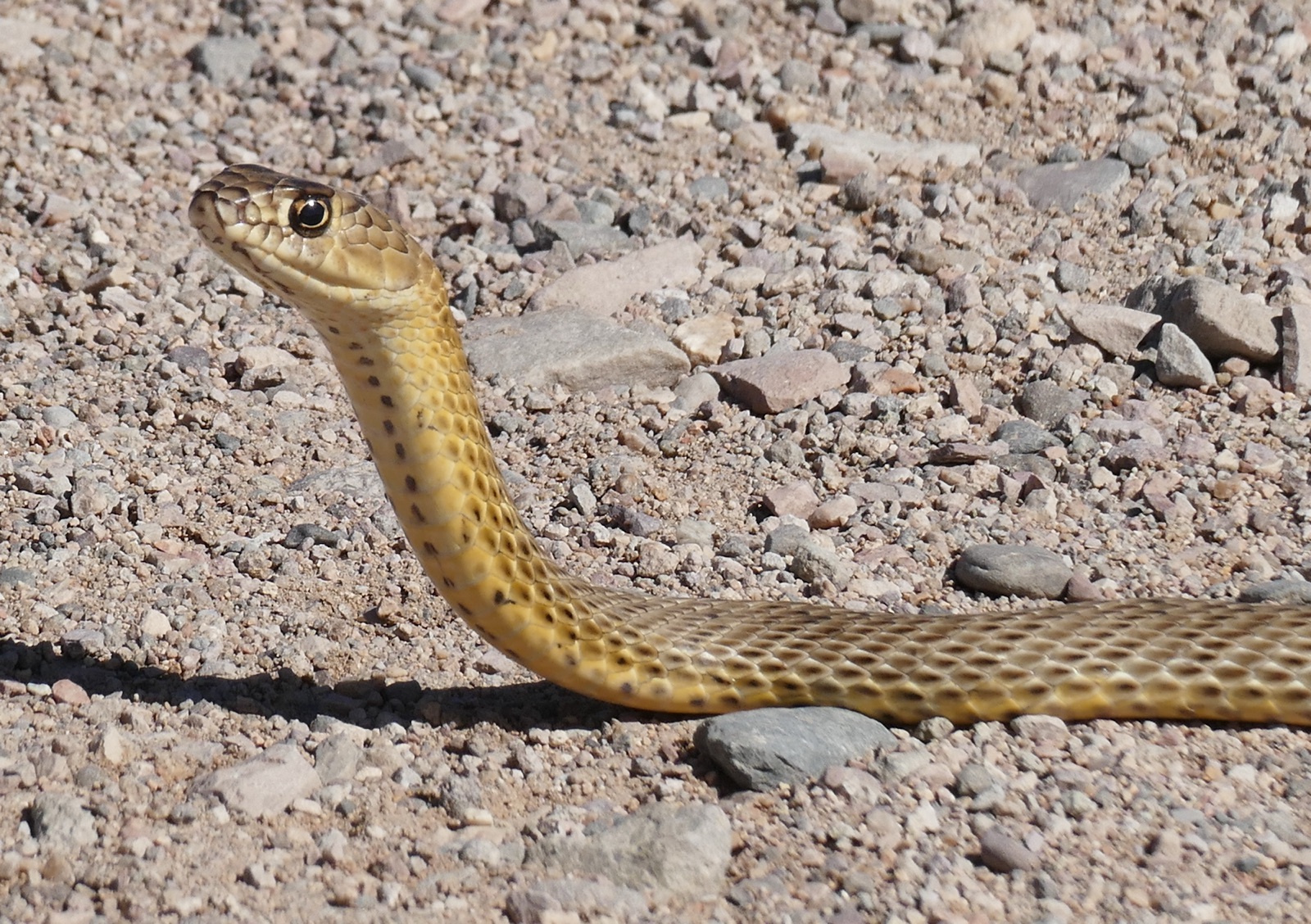
Trail runners meet snakes more often than most people outdoors. A runner covers several kilometres of trail in an hour, often early in the morning or late in the day, when many snakes are moving or basking. The good news is that a snake on a trail is almost never looking for a fight. Snakes do not chase people, and they cannot judge a runner's intentions. A snake usually bites in self-defense when it is stepped on, nearly stepped on, or cornered. For a runner, safety mostly comes down to one problem: seeing the snake before your foot reaches it.
Speed is what makes running different from hiking. A walker has time to notice a coiled shape and stop. A runner closes the gap in a second or two, and many snakes rely on camouflage and stay still rather than flee. Rattlesnakes and copperheads in the United States, Russell's vipers and saw-scaled vipers in India, and death adders in Australia all depend heavily on staying hidden. Contrary to popular belief, rattlesnakes do not always rattle before striking, so silence is not a safety signal. Vibration from footfalls does reach snakes through the ground, and many faster species, such as racers, coachwhips, and Australian brown snakes, will move off the trail well ahead of you. The ones that stay put are the ones to watch for.
The most effective habit is to look further ahead than feels natural. Try to scan roughly three to five metres in front of you instead of watching your own feet, and pay attention to sunny patches, trail edges, rock ledges, and stretches where grass or leaf litter crowds the path. Step onto logs and rocks rather than straight over them, because snakes often rest in the shaded gap on the far side. Avoid stepping blindly into tall grass to pass other runners. On technical singletrack, slow down through brushy sections where you cannot see the ground. A few seconds lost on a segment is a reasonable trade for keeping your feet where your eyes have already been.
Timing and conditions matter too. In warm regions, many snakes become active at dawn and dusk during hot months. Some, such as copperheads on summer nights and kraits across South Asia, are largely nocturnal. If you run before sunrise or after sunset, use a bright headlamp aimed at the trail, not just a dim glow at your feet. In cooler spring and autumn weather, snakes often bask on sun-warmed dirt, gravel, or pavement in the middle of the day, and can be sluggish and slow to move. Many runners also keep one ear free of earbuds, or skip music entirely, in snake country. A rattle, a hiss, or the rustle of a snake moving off is useful information.
Clothing helps but is not a guarantee. Most bites to people on foot land on the foot, ankle, or lower leg, so trail shoes with closed uppers, socks, and lightweight snake gaiters or long tights reduce the risk. They can also blunt the depth of a strike from smaller snakes. Sandals and bare ankles give no such margin. Running with others, carrying a phone, and telling someone your route are sensible in any remote area. That matters more where help is far away, as on many trails in outback Australia, rural India, and the desert Southwest of the United States.
If you do come upon a snake, the right move is simple: stop, then step back. Do not jump over it, try to sprint past, poke it with a stick, or try to shoo it off the trail. Each of those puts you inside its striking range, which for most snakes is a fraction of its body length but hard to judge in the moment. Give it a few metres of space and watch. Usually it will cross and disappear within a minute or two. If it stays, wait or turn back rather than forcing a wide detour through brush where you cannot see the ground. Never try to kill or handle the snake. Doing so is how many bites happen, and in much of the US, Australia, and India it can also be illegal. If anyone is bitten, seek professional medical help immediately by calling local emergency services.
Many runners want to know afterward what they just saw, and a quick photo helps. Take it only from where you already stopped, without stepping closer for a better angle. Zoom in, capture the head shape and body pattern if you can, and let SerpentID compare the markings against the species most likely in your area. Knowing whether a trail regularly hosts copperheads, eastern browns, or harmless racers tells you how carefully to run it next time. If the snake turns out to be venomous and is sitting on a busy public path, contact local wildlife services or park staff so they can warn other trail users.