


People search for snake tracks after finding a strange line in the dust on a garage floor, a wavy groove across a sandy trail, or a smooth drag mark through mud at the edge of a pond. The defining feature is simple: a snake trail has no footprints. Every mark comes from the belly and body pressing and sliding against the ground. That makes snake tracks easy to recognize once you know the main types, but much harder to read than the hoof or paw prints people usually learn first. Tracks show up best on fine, loose, or damp surfaces such as beach and desert sand, dusty paths, soft mud, fresh soil, light snow at the edges of the active season, and the thin film of dust on porches, sheds, and garage floors.
The most common trail comes from lateral undulation, often called serpentine movement. The snake pushes the sides of its body against small bumps, pebbles, and plant stems and throws its body into S-shaped curves, so the track is a continuous, gently winding groove. On sand or loose soil you will often see small ridges of material heaped up along the curves where the body pushed hard. Experienced trackers sometimes judge direction from which side of each bend the sand is piled on, but this is genuinely difficult on uneven ground. Even skilled field naturalists get it wrong, so treat any direction guess as tentative.
Heavy-bodied snakes sometimes leave a very different trail. In rectilinear movement the snake creeps forward in a nearly straight line by lifting and pulling sections of belly skin and scales, a bit like a caterpillar tread. The result is a broad, straight, or only slightly curving drag mark, often with faint crosswise scuffs from the belly scales. Large pythons and boas, puff adders, big rattlesnakes, and other stout vipers commonly move this way when they are traveling slowly and are not alarmed. A straight, wide belly drag across a dirt road is a reasonable sign of a sizable, heavy-bodied snake. Many harmless species can make similar marks, though, so it is still not a sign of venom.
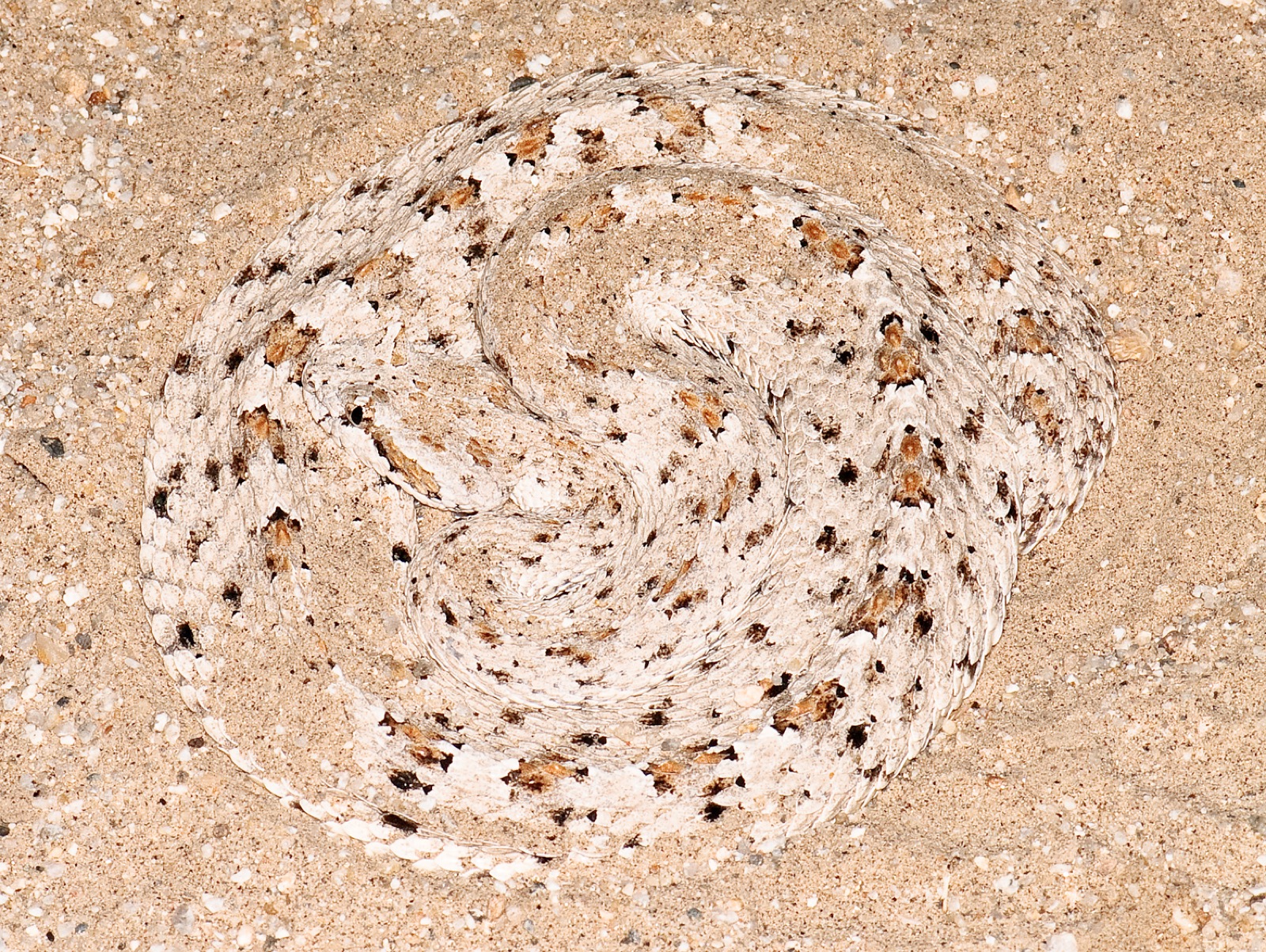
The trail most people picture from documentaries is sidewinding. In loose, shifting sand, snakes such as the North American sidewinder, the horned and sand vipers of Africa and the Middle East, and some saw-scaled vipers in arid parts of India lift most of the body off the ground. Only two short sections touch down at a time. Instead of one continuous groove, they leave a series of separate, parallel marks set at an angle to the direction of travel, each often with a small hook at one end. Several other snakes, including some Australian desert species, sidewind briefly on very loose sand. A fourth style, concertina movement, is used in tunnels, crevices, and climbing. It rarely leaves a clean track and usually shows only as bunched, scuffed marks in narrow spaces.
Plenty of other things get mistaken for snake trails. Bicycle and wheelbarrow tires make continuous lines too, but they are evenly wide, often show tread, and run in long smooth arcs rather than repeating S-curves. Lizards, including monitors in Australia and India and large skinks, can drag their tails and leave a wavy central line, but look closely and you will find footprints on both sides. Earthworms, beetle larvae, and caterpillars leave tiny winding trails that are far narrower than even a small snake's body. A stick or rope dragged by wind or water can leave a groove as well. Legless lizards make true snake-like trails, which is one more reason a track alone cannot settle identification.
What a trail can tell you is limited but useful. The width of the groove gives a rough idea of body thickness. Crisp edges, sharp sand ridges, and a track lying on top of morning footprints or overnight dew suggest the snake passed recently. Wind-softened edges, rain pocking, or other tracks crossing over it suggest the mark is older. What a trail cannot tell you is species, length, or whether the snake was venomous, and the old idea that you can spot a dangerous snake from its track is folklore. The safest response to a fresh trail is to slow down and scan the ground ahead, especially around rocks, logs, leaf litter, and the edges of paths. Do not follow a trail into brush. Never reach into a burrow, gap, or woodpile where a trail seems to end, because that is exactly where the snake is likely resting.
If the trail leads you to an actual snake, stop and give it plenty of room. Keep at least a couple of body lengths of space, or more, and never try to touch, move, or kill it. Most snakes simply want to keep going. From a safe distance, take a clear photo of the snake itself rather than its track, and let SerpentID compare the head shape, markings, and body pattern against the species most likely in your area. If the app suggests a venomous species, or the snake is in a spot where people or pets could stumble onto it, contact your local wildlife service or a licensed snake catcher to handle it. If anyone is bitten, seek professional medical help immediately.