


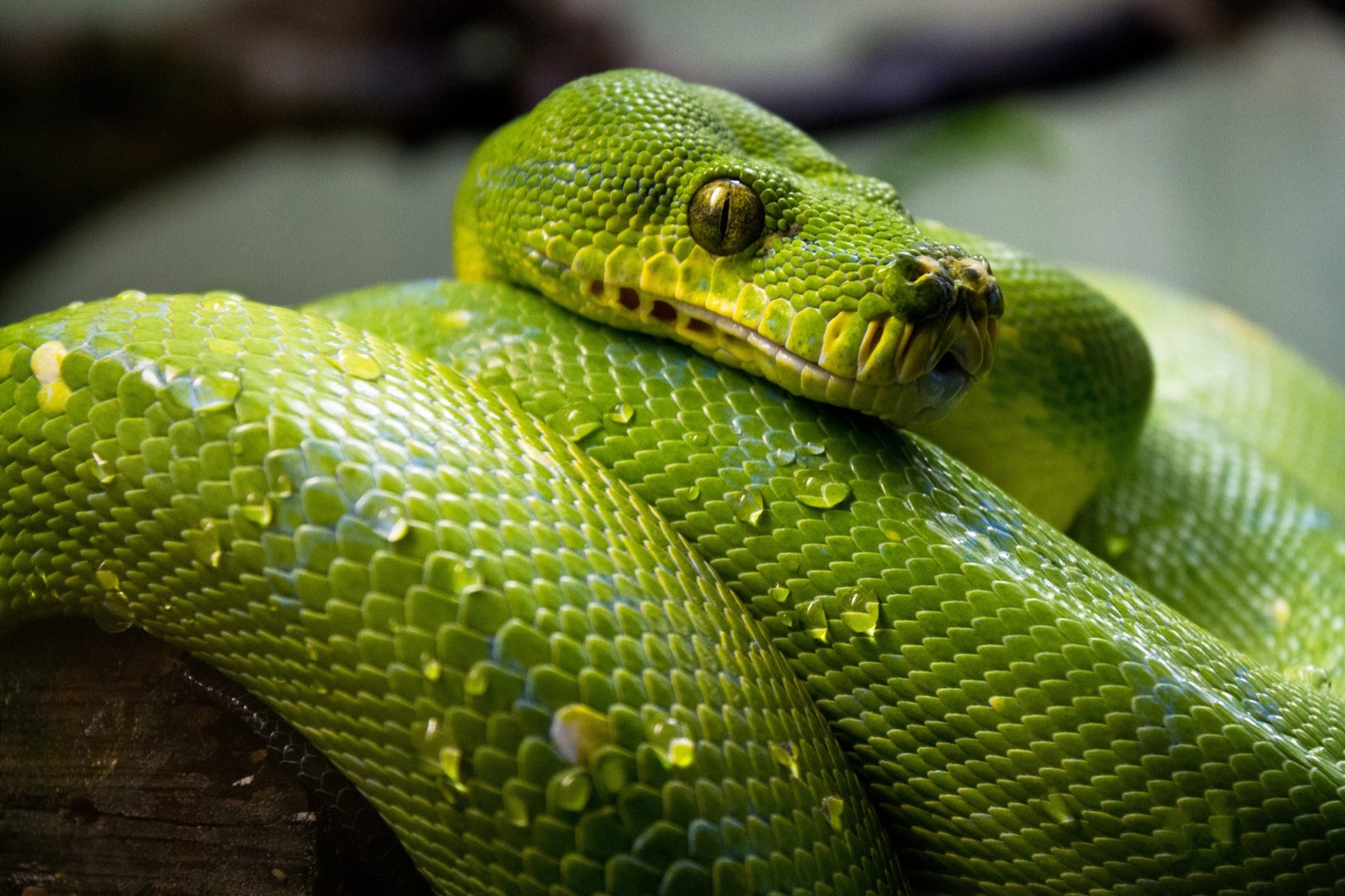
Few snake mix-ups in India carry higher stakes than this one. Russell's viper, Daboia russelii, is one of the Big Four species responsible for most serious snakebites in the country. The Indian rock python, Python molurus, is a non-venomous constrictor. Both are brown or tan with bold dark blotches, and both turn up in farmland, scrub, and village edges. Young pythons in particular can look a lot like vipers. Good news: several field markers separate them reliably, and almost all of them can be judged from several metres away or from a zoomed photo.
Start with the pattern, because it is usually the first thing you see. A typical Russell's viper has three rows of dark brown oval or rounded spots running down its body: one row down the back and one along each side. Each spot is usually outlined in black and then edged with a thin pale or white rim, so the pattern looks neat, repeated, and almost chain-like. That is why the snake is often called the chain viper. The rock python's blotches are larger, more irregular, and often join into broad, uneven saddles. Its pattern looks more like a patchwork than a tidy chain of rings. Colours vary between regions and individuals, so check the overall arrangement as well as the shade.
Next, look at the head and the texture of the skin. Russell's viper has a broad, flattened, distinctly triangular head clearly wider than the neck. It is covered in many small scales and often marked with pale lines that form a V pointing toward the snout. Its eyes have vertical pupils, and its nostrils are noticeably large. The body scales are strongly keeled, which gives the snake a dull, rough, matte look. The rock python has a longer head with a dark arrowhead or spear-shaped mark on top and a dark stripe running back through each eye. Its snout is covered in larger plates, and it has small heat-sensing pits along its lips. Its scales are smooth and often look glossy. Head shape alone is not a reliable venom test, but in this pair the overall combination of head, eye, and scale texture is consistent.
Size and build help too, with some caution. Adult Russell's vipers are heavy-bodied but rarely much longer than about one and a half metres, and most are closer to a metre. Rock pythons can reach several metres and very thick bodies, so a truly huge snake is almost certainly a python. Small pythons and young vipers, however, overlap in length. That makes size useful only at the extremes. Body proportions are a better clue: the viper looks short and stocky with a fairly short tail, while even a young python looks longer and more muscular in its build.
Behaviour can give the game away, but it should never be tested. Russell's viper is famous for a loud, long, pressure-cooker-like hiss, among the loudest of any Indian snake. It often coils in a tight, S-shaped posture when disturbed and can strike quickly. Rock pythons are generally slow and may hiss too, but they tend to try to escape or stay still. Remember that Russell's viper is a master of camouflage and frequently lies motionless in grass, leaf litter, or field bunds. Many bites happen when someone steps on or reaches near one without seeing it. A common folk belief says a calm, quiet snake must be harmless. That belief is dangerous, because a still viper is often simply relying on camouflage. Another source of confusion is the common sand boa. It is also stout and blotchy and is often mistaken for a viper, which shows how easily people misjudge these patterns.
If you are not completely sure which snake you are looking at, the safe call is to treat it as a Russell's viper. Do not try to catch, corner, or kill it. Snakes in India are protected under wildlife law, and most bites happen during attempts to handle or kill them. Keep children and pets away, step back to at least a few body lengths, and watch where the snake goes. A Russell's viper bite is a medical emergency: seek professional medical help immediately at a hospital with antivenom, and avoid traditional remedies or delays.
The most useful thing you can do in the moment is to take a clear photo from a safe distance, using your phone's zoom rather than your feet. Try to capture the body pattern, and the head if possible. SerpentID can compare the spots, scale texture, and head markings against the species most likely in your area, helping you tell a chain-patterned viper from a blotchy python. If the result points to a Russell's viper or remains uncertain, contact your local forest department, wildlife helpline, or a trained snake rescuer so the animal can be moved safely by someone equipped to do it.