


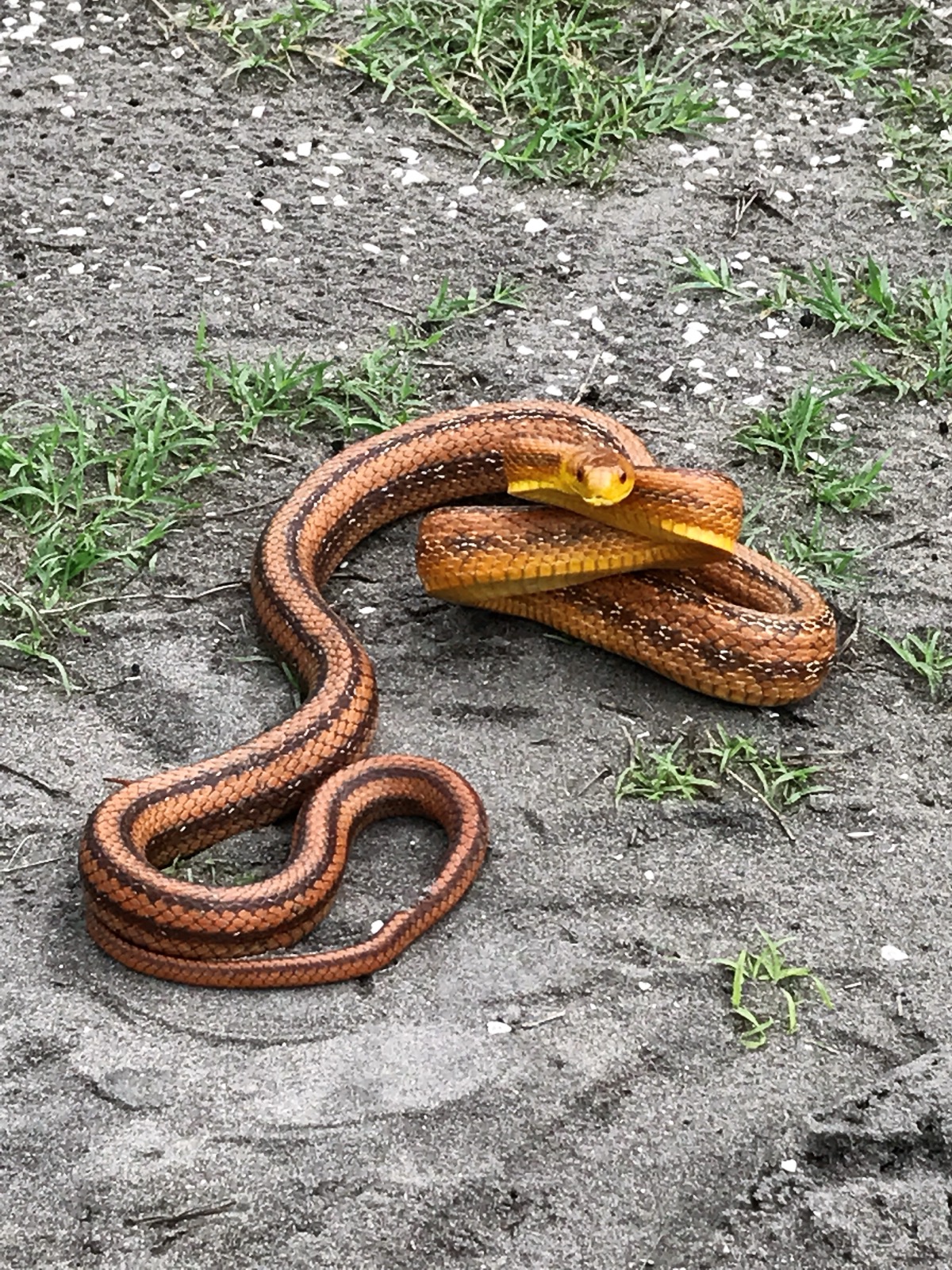
Rat snake vs copperhead is one of the most practical backyard comparisons because both species can turn up where people actually live: fence lines, sheds, retaining walls, wood piles, barn edges, and brushy property margins. The confusion usually starts when someone sees pattern first and decides danger second.
The full-body impression is usually the cleanest separator. Rat snakes often look longer and more stretched out, especially when part of the body is climbing or anchored across brush, boards, or stone. Copperheads usually read heavier through the middle, with a more compact and stout impression even when the snake is not fully coiled.
Pattern structure helps once you stop relying on color alone. Copperheads are famous for the hourglass look across the body. Rat snakes can show blotches, darker saddles, or regional variation, but the marks usually do not create that same repeated narrow-at-the-top, wide-on-the-side rhythm that copperheads do so well.
Behavior can support the ID without becoming a shortcut. Rat snakes are strong climbers and regularly appear around vertical surfaces, bird activity, and rodent-heavy structures. Copperheads can use those spaces too, but the overall scene more often reads as a hidden ambush location than a stretched climbing snake working along a fence or shrub.
SerpentID helps most when the entire snake is visible, because the app can weigh both pattern and proportions. If confidence is poor or copperhead remains in the result set, act conservatively anyway. Good identification improves judgment, but it does not replace distance and caution.