


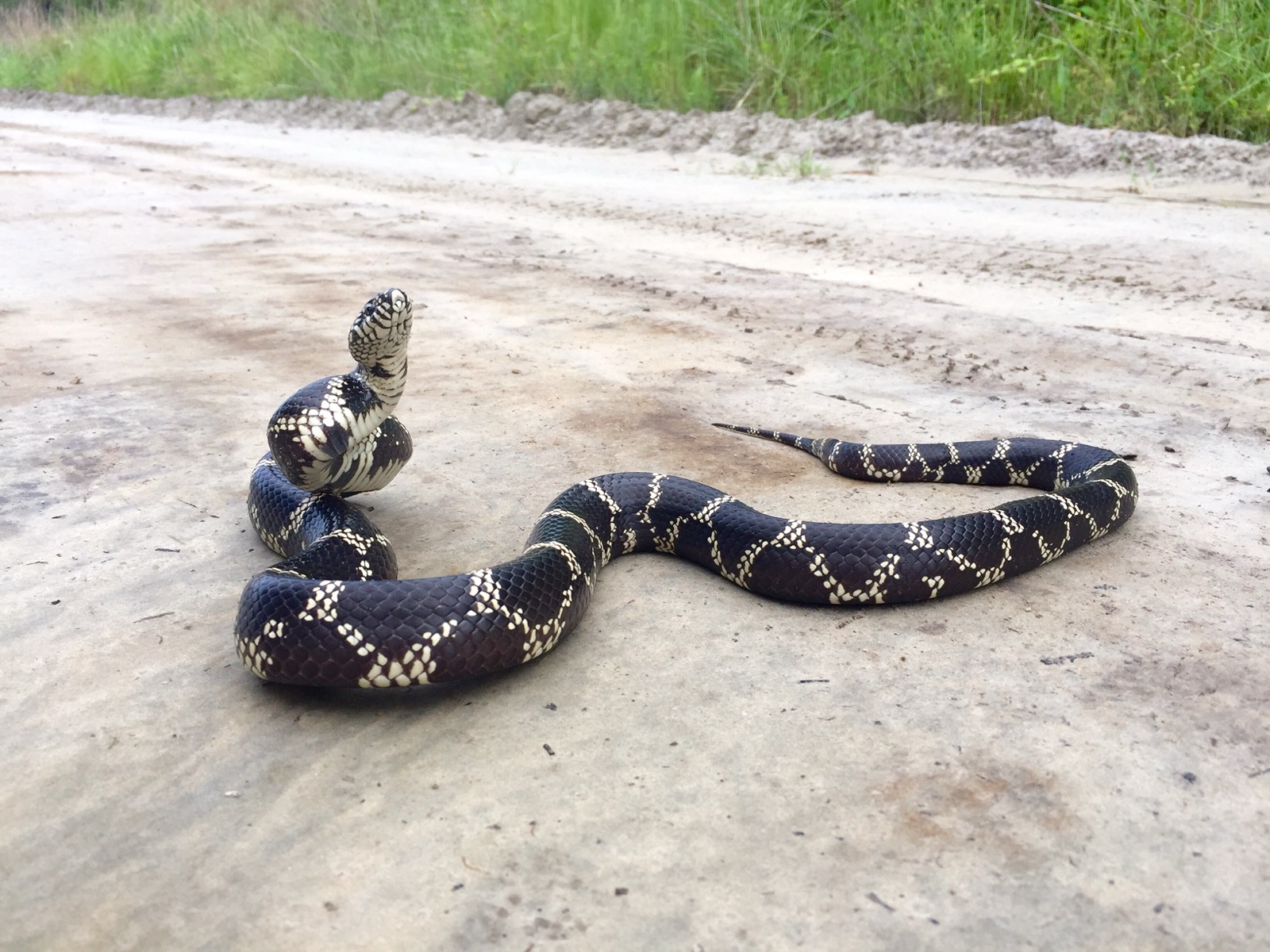
Kingsnake vs rattlesnake searches usually happen after someone sees a dark patterned snake crossing a trail, driveway, or roadside shoulder and immediately looks for one final proof marker. The mistake is assuming the tail will solve everything before you assess the rest of the snake.
Start with the body pattern and finish. Kingsnakes often look glossy and cleanly patterned, with chain-like bands, rings, or contrasting marks that repeat along the body. Rattlesnakes usually read heavier and more segmented, with darker dorsal shapes and a more rugged-looking texture overall.
Body posture can separate the impression fast. A kingsnake often reads longer and more fluid in motion, while a rattlesnake usually gives a shorter, heavier-bodied visual impression when it pauses or coils. That does not mean behavior alone is reliable, but it helps when paired with pattern and build.
People also get trapped by the triangular-head shortcut. Plenty of harmless snakes can widen or angle the head in ways that look dangerous in a phone photo. If the image quality is weak, use larger field markers like body thickness, pattern rhythm, and whether the snake appears sleek or stout.
SerpentID is useful because it can reduce a vague 'dangerous maybe' moment into a tighter comparison set. But if the app says rattlesnake or remains uncertain, treat the scene conservatively. Distance and a blocked path for kids or pets are more important than proving the species name in real time.