


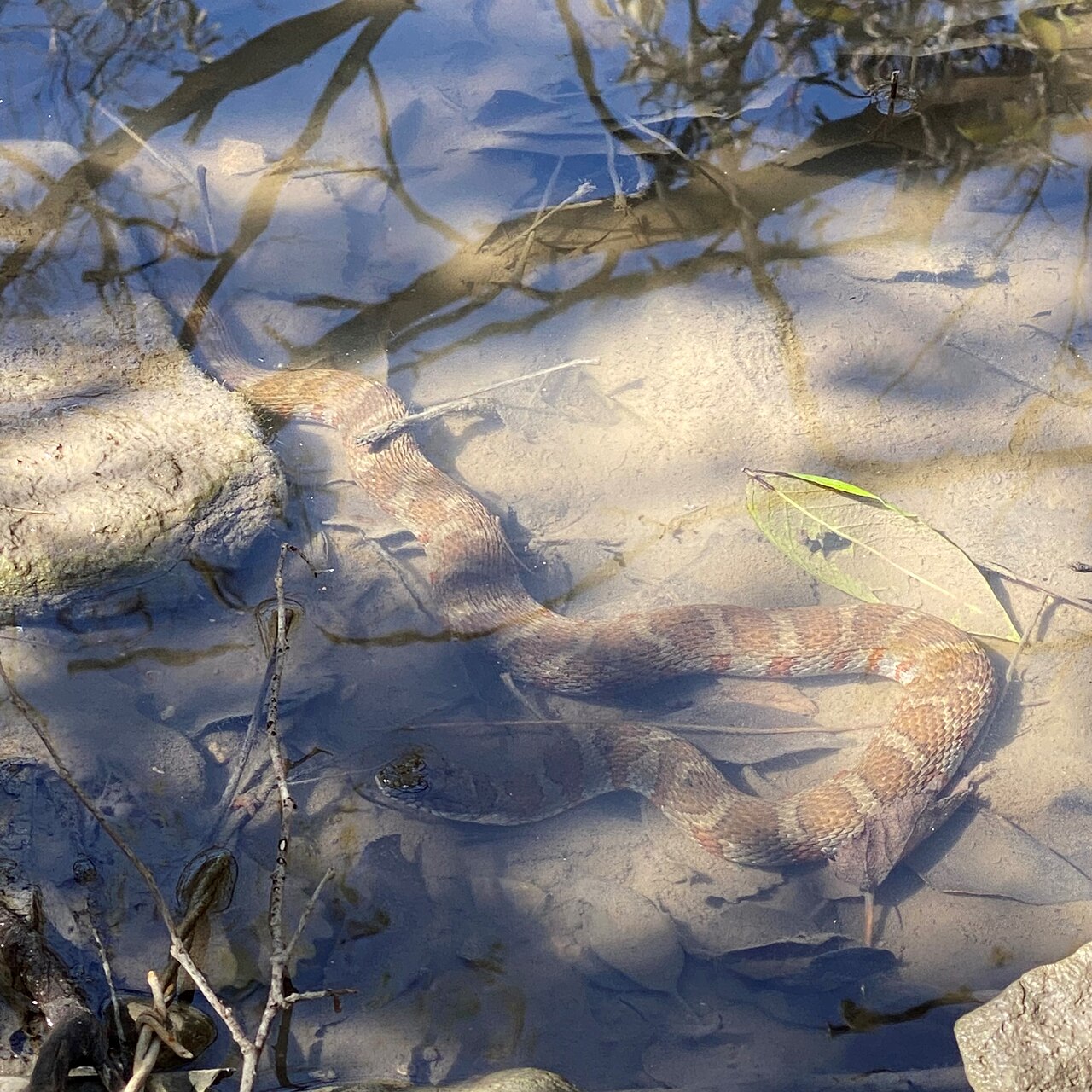
It is one of the most common questions people type after spotting something long and wriggling in a creek, pond, or tide pool: was that an eel or a snake? The short answer is that they are completely different animals that happen to share a body shape. Eels are fish. Snakes are reptiles. Their long, limbless bodies are a case of convergent evolution, where unrelated animals arrive at a similar design because it works well for slipping through water, mud, rocks, and narrow spaces. Knowing the difference matters, because the right response to a harmless fish is very different from the right response to a possibly venomous water snake or sea snake.
The biggest biological difference is breathing. True eels, such as the American eel in North America, the longfin and shortfin eels of Australia, and the many freshwater and marine eels found around India, breathe through gills. They take oxygen from the water and can stay submerged indefinitely. Every snake, including the most aquatic sea snakes, has lungs and must come to the surface to breathe air. So a long animal that repeatedly lifts its head or nostrils above the water, or swims along the surface with its head held up, is far more likely to be a snake. An animal that stays down near the bottom, hides under rocks, and never surfaces for air is behaving like a fish.
Fins and skin are the next clues, and they can often be seen from the bank without getting close. Most eels have a soft fin running along the back and underside that merges into the tail, plus small pectoral fins just behind the head and a gill opening on each side. Their skin looks smooth and is coated in protective mucus, which is where the slippery reputation comes from; any scales they have are tiny and embedded. Snakes have no fins and no gill openings. Their bodies are covered in distinct overlapping scales that are dry to the touch, not slimy, even when the snake has just left the water. A snake also flicks a forked tongue to sample scent, a behavior no eel shows.
Movement and posture help too. Snakes in water swim with side-to-side waves of the whole body, much like they move on land, and many species bask on branches, logs, or rocks along the shore. North American water snakes in the genus Nerodia and the venomous cottonmouth are frequently seen sunning at the water's edge, as are keelbacks in Australia and the checkered keelback in India. Eels do not bask. They may wriggle briefly across wet ground at night, and young eels can climb damp surfaces during migration, but they spend nearly all their lives underwater. If the animal is draped on a branch or lying in the sun on a rock, it is a snake.
Some animals make the call harder, and it helps to know the usual suspects. Sea snakes have flattened, paddle-shaped tails that can look fin-like, but they still have scales, no gills, and must surface to breathe; they are highly venomous, and although they are generally not aggressive toward people, they should never be handled, including when one ends up in a fishing net. Snake eels, a family of marine fish, look remarkably snake-like but are true eels. The electric eel is not an eel at all but a South American knifefish. In the southeastern United States, amphiumas and sirens are long aquatic salamanders, sometimes called congo eels or mud eels, that have tiny legs if you look closely. In India, swamp eels are another snake-like fish often mistaken for snakes in flooded fields and rice paddies.
A few myths are worth clearing up. Eels are not baby snakes, and snakes do not turn into eels or the reverse. Being in water does not make a snake harmless, and being slimy does not make an animal dangerous. Eels can bite if grabbed, and some large marine eels such as morays can deliver painful wounds, but eels are not venomous in the way some snakes are. Meanwhile, many harmless water snakes are killed because they are mistaken for cottonmouths, and some people underestimate genuinely venomous species because they assume anything in water must be a fish. The safest approach is to treat any unidentified long animal in or near water as something to watch, not touch. If anyone is bitten by an animal that may have been a snake, seek professional medical help immediately.
If you want to know exactly what you saw, the best tool is a clear photo taken from a safe distance. Stay well back from the water's edge, do not try to lift rocks, poke at the animal, or pull it out with a stick, and use your phone's zoom to capture the head, the body texture, and any visible fins or tail shape. SerpentID can compare those markings against the snake species likely to be found in your area, which helps you rule a snake in or out and narrow down which one it might be. If the result points to a venomous species near a home, dock, swimming spot, or boat launch, contact your local wildlife service or a licensed snake relocation professional rather than handling it yourself.