


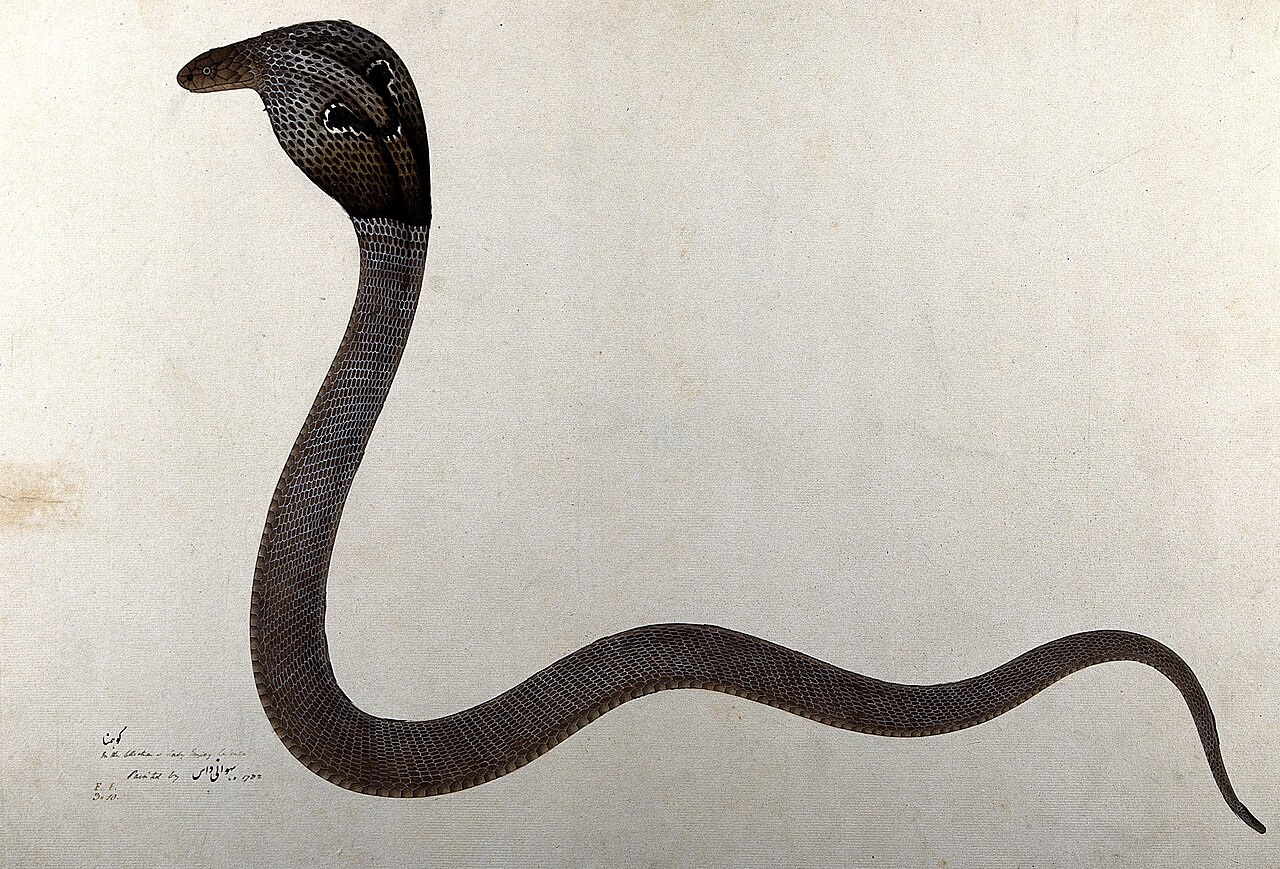
Across much of India, two large snakes turn up in the same places: paddy fields, sugarcane plots, grain stores, cattle sheds, and the edges of villages and towns. One is the Indian rat snake, Ptyas mucosa, known as dhaman in Hindi and by many regional names. The other is the spectacled cobra, Naja naja, one of the Big Four species responsible for most serious snakebites in the country. Both are long, both can be brown, olive, yellowish, or dark, and both raise the front of the body when cornered. That overlap is why so many harmless rat snakes are killed as cobras, and, more dangerously, why some people approach a cobra believing it is just a dhaman. Knowing a few dependable differences helps, but the safest habit is to make every judgment from a distance.
The hood is the single most useful clue. When a cobra feels threatened it lifts its head and forebody and spreads a broad, flat hood by extending long ribs behind the head sideways. Seen from the front, the neck becomes much wider than the head, and many spectacled cobras show the dark spectacle-shaped mark on the back of the hood. An Indian rat snake cannot do this. When it is cornered it may raise its forebody, inflate its throat, and make a low growling or hissing sound, but the inflation is vertical, puffing the throat downward into a keel rather than flaring outward into a disc. If you see a flat, wide hood, you are looking at a cobra. The trouble is that a calm or fleeing cobra often keeps its hood down, so the absence of a hood does not prove a snake is harmless.
The head and face give a second set of clues. Rat snakes have large, prominent eyes with round pupils and a fairly distinct head, and the scales along the upper and lower lips are usually edged with dark vertical bars, giving the mouth a lined or striped look. Cobras have a more rounded, smoothly blended head with smaller-looking eyes, and their lip scales are generally plain. Many spectacled cobras also have one or two dark bands or spots on the underside of the throat, just below the hood, which may be visible when the snake rears up. Be cautious with eye-shape rules, though. Cobras also have round pupils, so pupil shape alone will not separate these two species, and the old belief that slit pupils mean venom and round pupils mean safety fails badly in India.
Body proportions and pattern help when the snake is stretched out or moving away. The Indian rat snake is slender and very long, commonly around 1.5 to 2.5 metres, with a long, tapering, whip-like tail. Toward the rear of the body and along the tail, its scales are often edged in black, forming a netted or crossbarred pattern that stands out against the lighter base colour. Cobras are heavier-bodied for their length, with a comparatively shorter tail and glossy scales that tend to be more uniformly coloured, although juveniles and some regional forms may show pale bands. Colour itself is a poor guide: both species range from pale yellow-brown to nearly black, and melanistic cobras in particular are easily mistaken for dark rat snakes.
Behaviour adds context but should never be the deciding factor. Rat snakes are fast, mostly daytime hunters that cover a lot of ground chasing rodents, frogs, and birds, and they usually flee at speed when disturbed. Cobras are active by day and around dusk, often rest in rodent burrows, termite mounds, and gaps in walls, and tend to stand their ground and display when cornered. Both, however, will defend themselves, and an Indian rat snake can bite hard if handled. Its bite is not venomous, but any bite from a snake you have not identified with certainty should be treated as serious: seek professional medical help immediately rather than waiting to see what happens.
Several popular beliefs blur the picture further. A widespread myth holds that the dhaman is the male of the cobra, or that the two pair up and travel together. They are entirely separate species from different families, and they do not mate with each other. Another story claims rat snakes suck milk from cows; snakes cannot suckle and do not drink milk. Some people also believe a rat snake's tail lash is poisonous, which is untrue. What is true is that rat snakes are valuable allies to farmers, eating large numbers of rats that damage crops and stored grain, and the rodents they hunt are often the same prey that draws cobras close to homes. Killing a rat snake removes a natural rodent controller and puts the person attempting it within striking range.
If you find a large snake in a field, courtyard, or storeroom, keep at least a couple of body lengths away, keep children and pets back, and do not try to provoke it into raising a hood so you can check. Instead, photograph it from a safe distance, ideally capturing the head, the lip scales, and the rear of the body, and let SerpentID compare those markings against the species most likely in your area. If there is any chance it is a cobra or another venomous species, or if it is inside a home, contact your local forest department, wildlife services, or a trained snake rescuer to move it safely.