


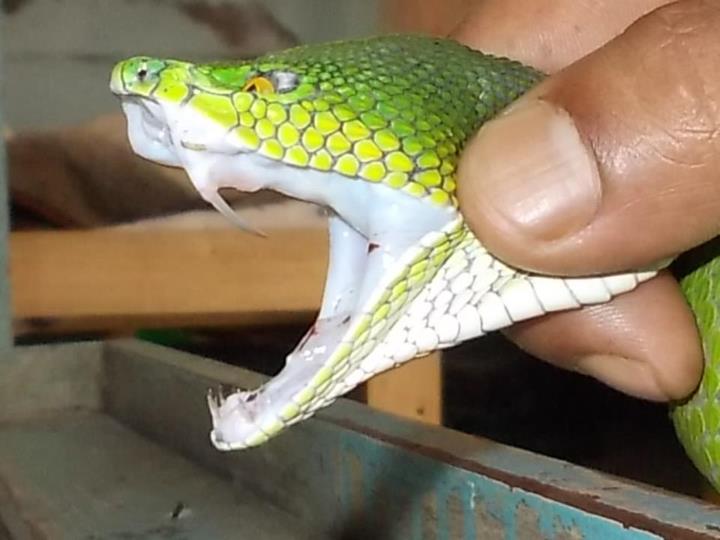
People are often surprised that one of the most feared substances in nature has ended up in pharmacies and hospital labs. The reason is simple. Snake venom is not a single poison. It is a mixture of many proteins and peptides, and each one evolved to act on a specific part of a prey animal's body, such as blood pressure, blood clotting, or nerve signals. That precision is exactly what drug designers look for. A molecule that strongly targets one process can, once it is understood, isolated, and modified, be turned into a treatment that targets that same process in a controlled way.
The best-known example began with the jararaca, a South American pit viper (Bothrops jararaca). Researchers in Brazil noticed that people bitten by this snake suffered a sharp fall in blood pressure. Work through the 1960s and 1970s traced the effect to small peptides in the venom that interfere with an enzyme the body uses to raise blood pressure, called angiotensin-converting enzyme, or ACE. Chemists used those peptides as a model to design captopril, the first ACE inhibitor, which was approved in the United States in 1981. Captopril and the many ACE inhibitors that followed it are now among the most widely prescribed drugs for high blood pressure and heart failure. The pills themselves contain no venom. They are synthetic molecules whose design was inspired by it.
Venom proteins that stop blood clotting have also become medicines. Many vipers carry proteins called disintegrins that prevent platelets from sticking together. Eptifibatide was developed from barbourin, a disintegrin found in the venom of the southeastern pygmy rattlesnake, a small species native to the US Southeast. Tirofiban was modeled on echistatin, a protein from the saw-scaled viper, a dangerous snake found across parts of Africa, the Middle East, and India. Both drugs are given in hospitals to some patients having heart attacks or procedures to open blocked arteries, where preventing a new clot can be lifesaving. Some people also mention exenatide, a diabetes drug, in lists of venom-derived medicines, but it actually came from the saliva of the Gila monster, a lizard rather than a snake.
Venom also works quietly behind the scenes in diagnostic labs. Russell's viper, one of India's Big Four venomous snakes, has venom that powerfully activates the clotting system. Purified preparations of it are used in a standard blood test called the dilute Russell's viper venom time, which helps doctors detect a clotting disorder known as lupus anticoagulant. Enzymes from other snakes are used in different clotting tests, including ecarin from the saw-scaled viper and reptilase, also called batroxobin, from a South American lancehead. Researchers in Australia have long studied the unusually potent clotting factors in taipan and brown snake venoms, both to understand how these bites harm people and to explore possible new tools.
The most direct medical use of venom, of course, is making antivenom. Venom is collected under controlled conditions by trained staff at licensed facilities, then used in carefully measured doses to immunize animals such as horses or sheep. Their antibodies are purified into the antivenom that hospitals give to bite victims. It is worth being clear about what venom medicine is not. Raw venom is not a cure for arthritis, cancer, or pain, and products sold online with venom claims are generally unproven. Some venom components are being studied for pain relief, cancer, and other conditions, but promising lab results are not the same as a safe, approved treatment. Venom collection is a skilled and dangerous job, and nobody should try to capture, provoke, or milk a wild snake.
This research is also one of the strongest arguments for protecting snakes rather than killing them. Each species carries its own chemical toolkit, and many venoms have barely been studied. A drab pit viper in a Brazilian forest gave the world a class of blood pressure drugs, and a small rattlesnake from the southeastern United States contributed to modern heart care. Losing species to habitat destruction or persecution means losing chemistry that scientists have not yet had the chance to explore. It also matters for antivenom, since the most effective products are made from the venom of the snakes that actually bite people in a given region.
Respecting what venom can do starts with knowing which snake is in front of you. If you spot a snake in your yard, on a trail, or near your home, stay well back and do not try to catch, move, or kill it. Take a photo from a safe distance and let SerpentID compare its markings against the species likely to live in your area, so you can tell a harmless neighbor from a medically significant one. If the snake turns out to be venomous or is in a place where people or pets could be at risk, contact your local wildlife services or a licensed snake catcher. If anyone is bitten, seek professional medical help immediately.