


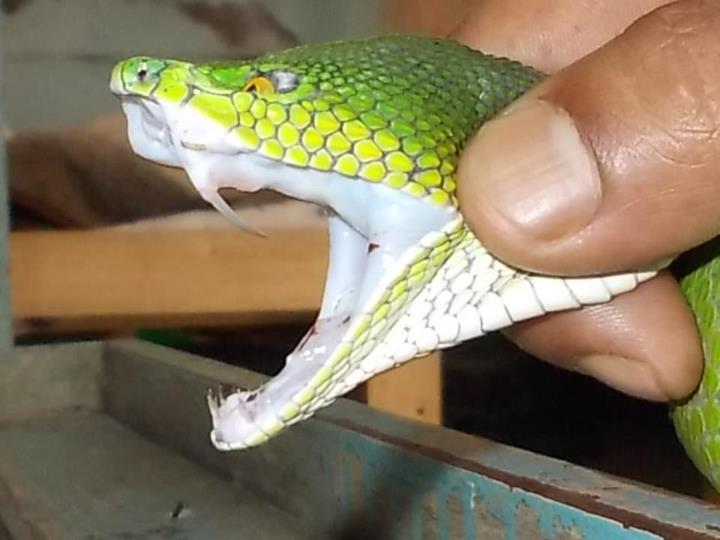
Many people marvel at a snake's ability to consume prey items that appear impossibly large, often far exceeding the size of their own heads. A common misconception is that snakes "dislocate" their jaws to achieve this feat. In reality, a snake's unique anatomy allows for incredible jaw flexibility and expansion without any dislocation. It's a testament to millions of years of evolution, enabling these reptiles to take full advantage of a meal when they find one, no matter how substantial.
The secret lies in the specialized structure of a snake's skull. Unlike mammals, whose lower jaw is a single bone fused at the front, a snake's lower jaw is composed of two halves, connected at the front by a highly elastic ligament. This allows each half to move independently. Furthermore, the upper jaw bones are not rigidly fused to the rest of the skull; instead, they are loosely connected by ligaments, and a unique bone called the quadrate bone acts as a hinge, allowing the mouth to open incredibly wide, sometimes up to 150 degrees or more. This entire arrangement provides a remarkable degree of mobility and expansion.
With such a flexible jaw, snakes employ a fascinating "walking" motion to engulf their prey. They use alternating movements of their left and right upper and lower jaws, essentially "ratcheting" their mouth over the meal. One side of the jaw will grip the prey with its backward-pointing teeth, while the other side extends forward, then grips, pulling the prey deeper into the throat. This process continues, slowly but surely, with each jaw segment moving independently to pull the food inward. The sharp, recurved teeth ensure a firm grip and prevent the prey from escaping as it's being swallowed.
The ability to swallow large prey extends beyond just the jaws. A snake's skin and throat are also incredibly elastic and can stretch dramatically to accommodate the bulk of a large meal. Their ribs are not fused to a sternum, allowing the body cavity to expand considerably. Perhaps one of the most ingenious adaptations is the ability of the trachea, or windpipe, to extend forward out of the mouth. This ensures that the snake can continue to breathe even when its mouth is completely full of food, a critical feature during what can be a prolonged swallowing process.
Once the prey is fully swallowed, the snake's powerful digestive system takes over. This process can be lengthy, sometimes taking days or even weeks for very large meals, depending on the snake's size, the temperature, and the size of the meal. The energy expenditure for digestion is significant, often causing a noticeable increase in the snake's body temperature. This efficient system means that snakes do not need to eat frequently, often going weeks or months between meals after consuming a large item.
So, while the visual of a snake consuming a meal much larger than its head might look like a painful or impossible act, it's a perfectly natural and highly evolved process. There is no "dislocation" in the sense of an injury; rather, it's an intricate dance of flexible bones, elastic ligaments, and specialized muscles working in harmony. This extraordinary adaptation highlights the incredible diversity and ingenuity of nature's designs, allowing snakes to thrive in various environments by exploiting a wide range of food sources.
Encountering a snake in your yard or in the wild, especially one that might have recently consumed a meal, can be a surprising experience. If you spot a snake, the best approach is always to observe it from a safe distance without disturbing it. If you need help identifying a species, particularly if you are concerned about its presence in a residential area, take a clear photo from a safe distance. The SerpentID app can then help you compare its markings against likely local species, providing valuable information. If you suspect a venomous snake, contact local wildlife services for assistance; never attempt to handle or remove it yourself.