


How do snakes move without legs is one of the most natural questions to ask about an animal built as a single long muscle. The short answer is that a snake moves by pushing parts of its body against the ground and letting friction do the rest. Its skeleton — a skull and a long chain of vertebrae, each carrying a pair of ribs — works with powerful body muscles and the broad scales on its belly to grip surfaces and drive the body forward, no limbs required.
The most familiar style is lateral undulation, the classic 'slithering' wave you picture when you think of a snake. The snake throws its body into a series of S-shaped curves and pushes the back edge of each curve against small irregularities in the ground — pebbles, plant stems, ruts — so the whole body slides forward along the path the head traced. It is fast and efficient on rough ground and in water, which is why most snakes use it most of the time.
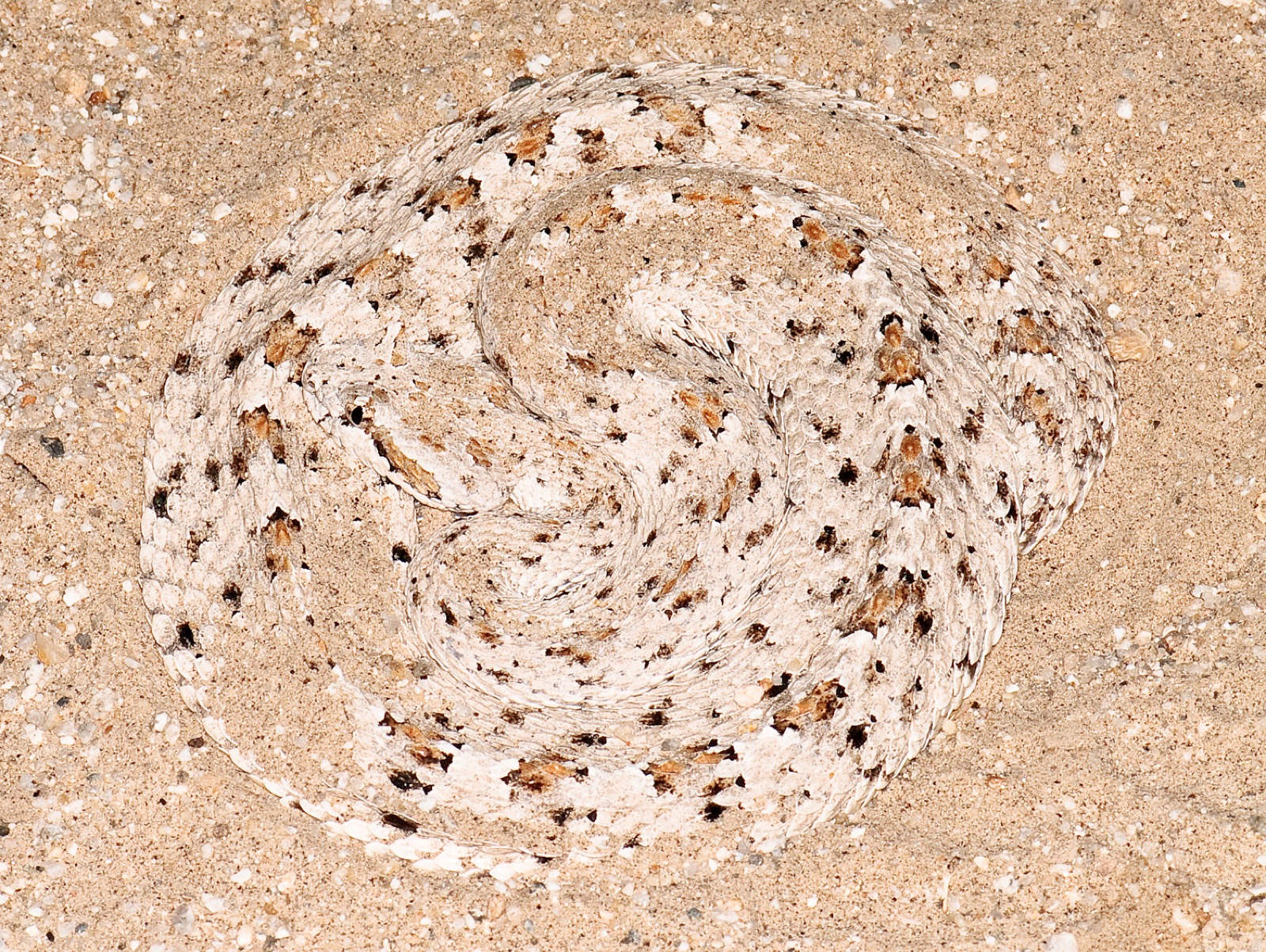
On loose or slick surfaces where there is nothing to push against, many desert snakes switch to sidewinding. Instead of flowing forward, the snake lifts loops of its body and lays them down ahead at an angle, so only two short sections touch the sand at any moment while the rest is briefly off the ground. This rolling, looping motion leaves the distinctive parallel J-shaped tracks you see in the photo above and keeps most of the body off hot, shifting sand.
Two slower methods handle tight spaces and big bodies. In rectilinear movement, a snake travels in a nearly straight line by rippling its belly scales — anchoring some, pulling the body over them, then anchoring the next set — which lets heavy snakes like large pythons creep forward almost imperceptibly. In concertina movement, the snake bunches into folds, anchors the front, extends, then pulls the rear up like an accordion, which is how snakes climb narrow burrows, branches, and the inside of pipes.
All four methods share the same engine: waves of muscle contraction running down the body, ribs and vertebrae giving those muscles something rigid to work against, and belly scales providing the directional grip. That grip is one-directional by design, which is why a snake glides forward smoothly but cannot easily be pushed backward — and why snakes can cross terrain, water, and vertical surfaces that would seem impossible for a legless animal.
Knowing how a snake moves does not tell you which species just crossed your path, and that is the part that decides how much room to give it. If a snake moves through your yard or trail and you want to know what it is, photograph it from a safe distance and let SerpentID compare its markers against likely local species — then decide whether to simply let it travel on or, for a venomous match, keep well clear and call local wildlife help.