


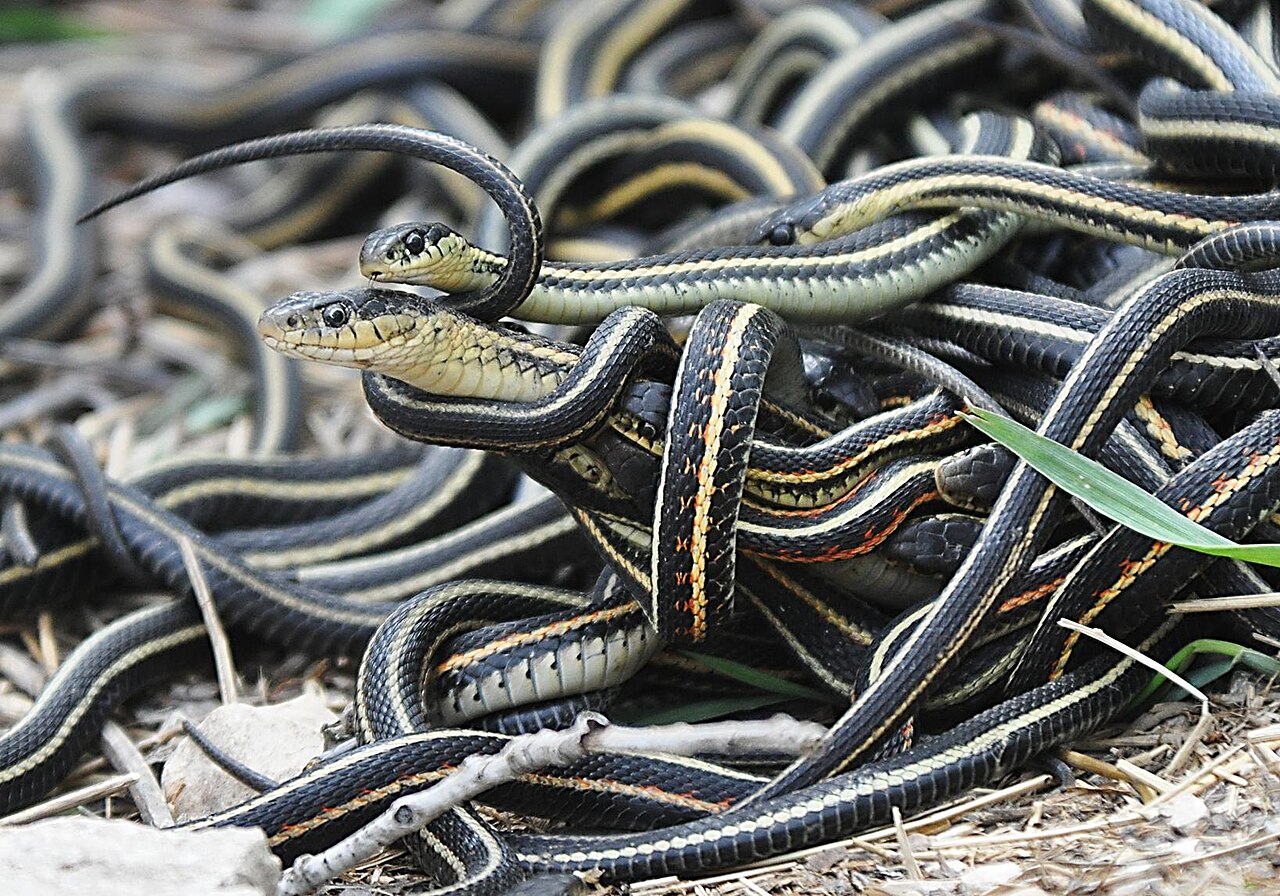
For most of the year, snakes lead solitary lives, hunting and resting without interacting with others of their kind. Because they lack vocal cords to call out and rely on vision that is often tuned for motion rather than fine detail, finding another snake across vast habitats might seem like a nearly impossible challenge. Yet every spring, snakes navigate across yards, fields, and forests to locate partners or shared hibernating sites with remarkably consistent success.
The primary secret behind this directional tracking is chemical communication. Female snakes secrete specialized lipids and proteins known as pheromones from their skin, particularly along their lower body and tail. As a female slithers across soil, grass, or gravel, she leaves behind a invisible trail of chemical markers. Male snakes use their forked tongues to collect these microscopic scent particles directly from the ground and air, transferring them to the Jacobson's organ in the roof of their mouth for processing.
Because a snake's tongue is split into two distinct tips, it acts as a directional compass for scent. If the right fork registers a stronger concentration of pheromone particles than the left, the male adjusts his path to the right. By constantly flicking his tongue as he crawls, a male snake can follow a chemical trail laid hours earlier across complex outdoor terrain. This delicate navigation system allows males to track females over distances spanning hundreds of yards without ever making visual contact until the final moment.
Chemical tracking is not limited solely to finding mates during the spring breeding window. In late autumn, many species also rely on scent cues to locate communal overwintering dens, known as hibernacula. Young snakes or individuals returning from summer foraging grounds follow scent trails left by established adult snakes to find deep rock crevices, abandoned burrows, or root systems that extend safely below the frost line.
Popular myths often suggest that seeing one snake in your garden means its partner is actively hunting for you nearby, but these encounters are almost always coincidence or seasonal timing. Aside from brief courtship periods or localized winter denning, snakes do not travel in mated pairs or maintain family units. If you spot a snake on your property, it is simply following food, shelter, or seasonal scents on its own terms rather than defending a territory with a companion.
If you encounter a snake following a trail across your lawn or garden, keep a respectful distance and leave it undisturbed. Taking a clear photograph from a safe position allows you to use SerpentID to compare markings and scale patterns against species native to your area. If you suspect the snake is a venomous species or if it is located in a dangerous area near children or pets, contact local wildlife professionals to handle the situation safely.