


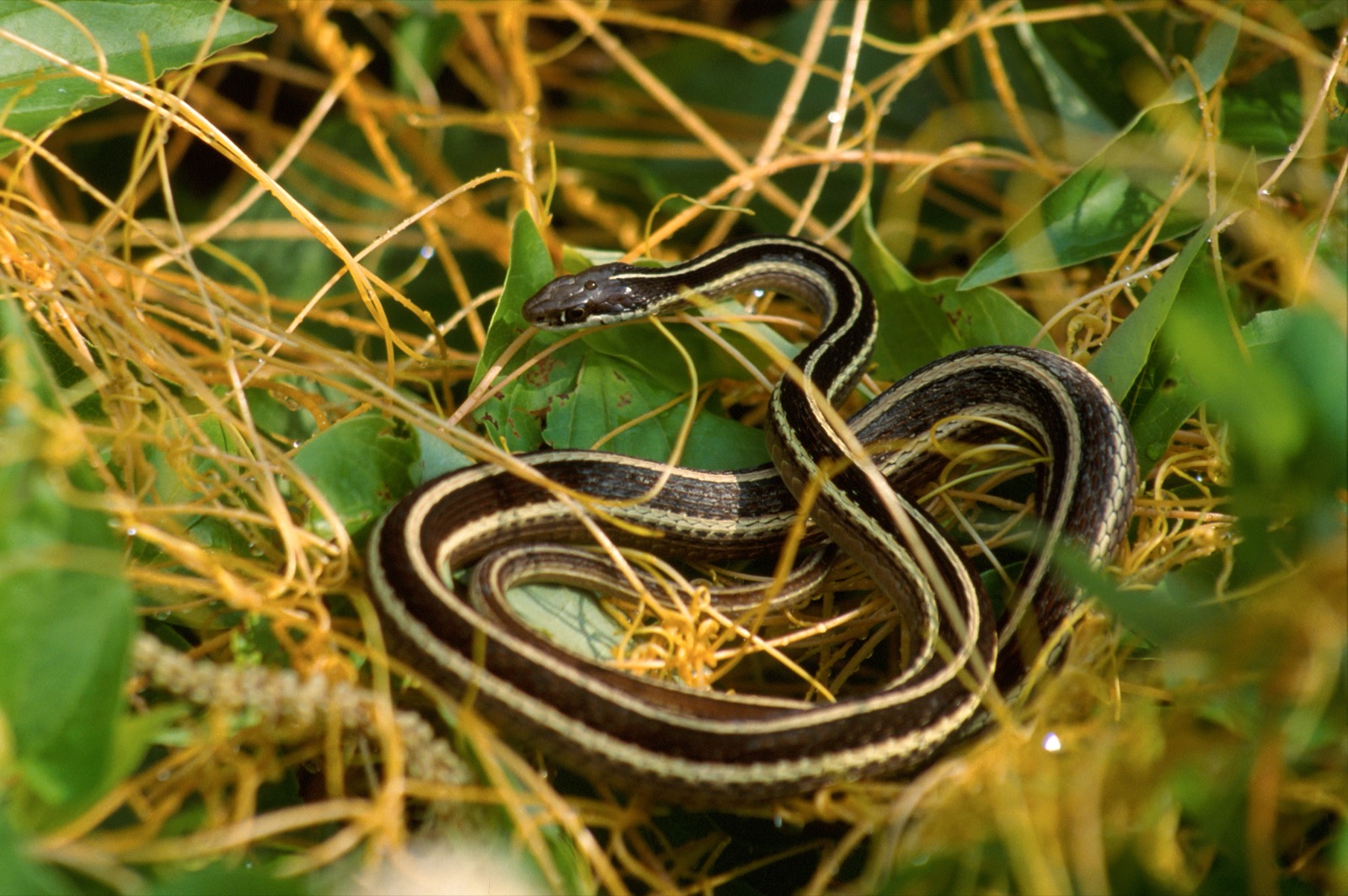
Garter snake vs ribbon snake is a useful SEO topic because most homeowners do not search for Latin names. They search after seeing a fast, slim striped snake and want to know whether it is the common garter snake they expect or something else. In many areas, ribbon snakes get labeled as garter snakes by default.
The cleanest difference is overall proportions. Ribbon snakes usually look more delicate and stretched out, with a longer tail and a more refined profile from head to tail. Garter snakes often look a bit stockier, especially through the middle of the body, even when they share a similar stripe pattern.
Stripe position helps too. Ribbon snakes often keep very crisp side stripes set higher on the body, which can make the snake look cleaner and more linear. Garter snakes can vary a lot by region, but the overall pattern frequently feels less streamlined and more variable in contrast.
Habitat can support the comparison without becoming the entire answer. Ribbon snakes are commonly tied to wetter margins, ponds, marsh edges, and grassy water-adjacent cover. Garter snakes also use those spaces, but they show up more broadly in yards, paths, and mixed suburban habitat. Use location as context, not proof.
SerpentID works best on this comparison when the whole snake is visible. A complete photo helps the app and the user judge length, stripe continuity, and body shape at once. If the result is low-confidence, keep the practical takeaway simple: it is usually a low-urgency encounter, but you still leave the snake alone and let it move off.