


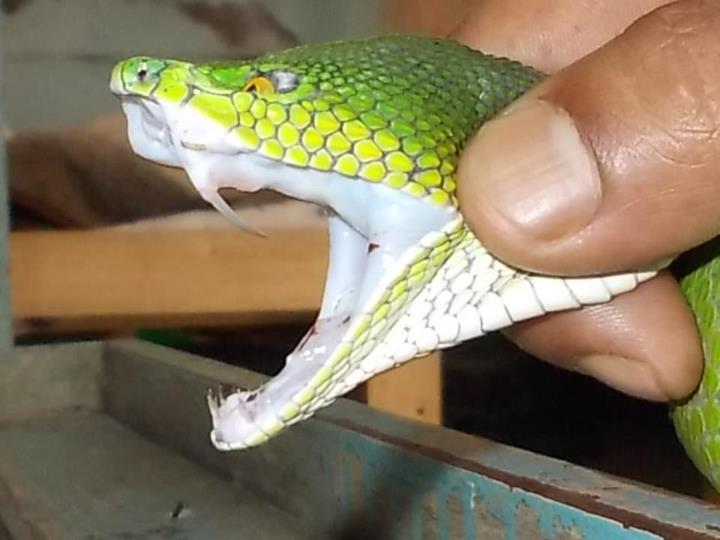
Do snakes have teeth is one of those questions where the answer is a clear yes, even though a snake's teeth are nothing like ours. Almost every snake has teeth — rows of small, thin, sharply pointed ones that curve backward toward the throat. They are not built for chewing, because a snake swallows its prey whole; instead they work like a one-way ratchet, gripping a struggling animal and walking it steadily down the throat so it cannot back out.
Most snakes carry these teeth in multiple rows. A typical non-venomous snake has teeth along the upper and lower jaws and often two extra rows on the roof of the mouth, adding up to dozens of tiny hooks. They are fragile and are lost and replaced continually throughout the snake's life, so a snake that breaks or sheds a tooth simply grows another — there is no single fixed set the way mammals have.
Fangs are a special kind of tooth, not a separate thing. In venomous snakes, certain teeth are enlarged and modified to deliver venom: vipers have long, hinged front fangs that fold back when the mouth is closed and swing forward to stab, while cobras and their relatives have shorter fixed fangs near the front. Some fangs are hollow like a hypodermic needle and others are grooved, but in every case a fang is a delivery tool layered on top of the ordinary gripping teeth.
This is why the presence of teeth tells you nothing about danger on its own. A harmless rat snake, garter snake, or kingsnake is fully equipped with teeth and can absolutely bite and draw blood — it just has no venom to inject. The meaningful distinction is not 'teeth versus no teeth' but whether a snake has venom-delivering fangs, and you cannot judge that by glancing into a closed mouth from a distance.
A bite from a non-venomous snake is usually a minor wound: a cluster of shallow scratches or pinpricks that should be washed and watched for infection, much like any small skin break. The teeth can leave debris behind, so cleaning the area matters. A bite from a venomous species is a different situation entirely and is treated as a medical emergency — but the point is that 'it has teeth' and 'it is dangerous' are two separate questions.
Because you should never open a snake's mouth or get close enough to count its teeth, the safe way to settle the real question — venomous or not — is from a distance. If a snake is close enough to be a concern, photograph it without crowding it and let SerpentID compare its visible markings against likely local species, then decide how much room to give it. If the match comes back venomous, keep well clear and contact local wildlife services.