


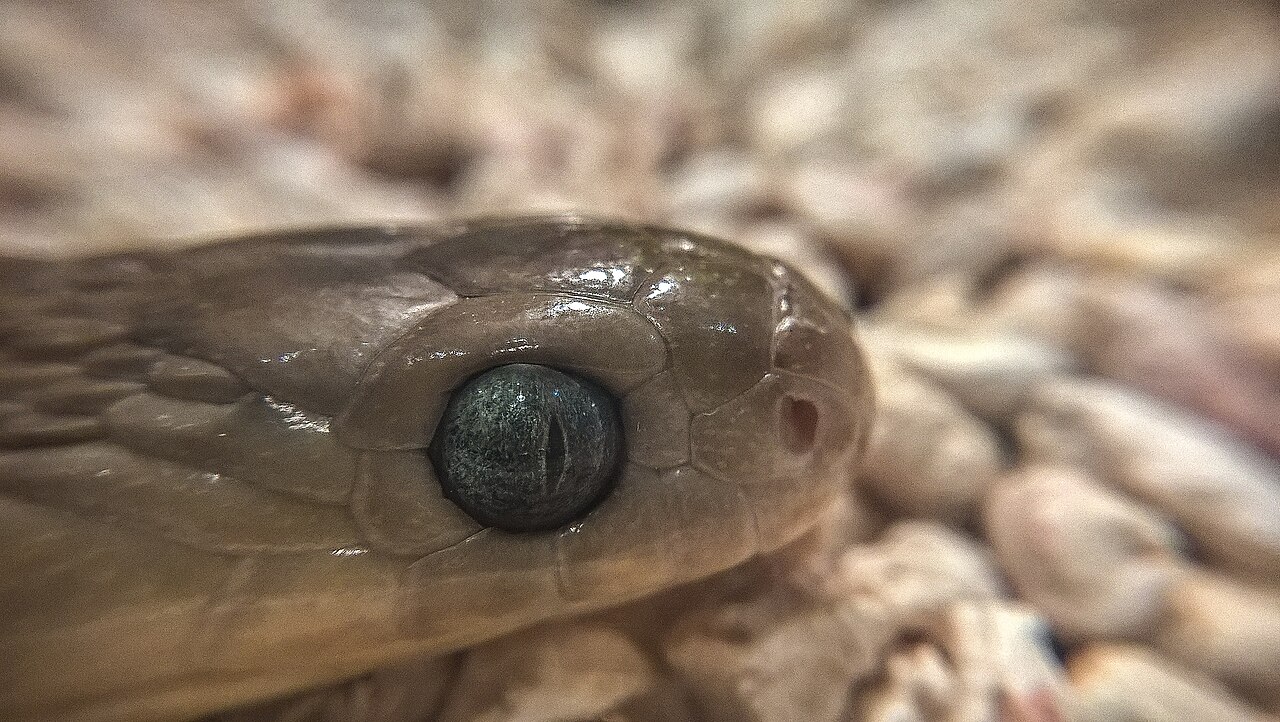
Do snakes have eyelids is a question with a surprising twist: the honest answer is both no and yes. Snakes have no movable eyelids — there is no flap to raise and lower, so a snake physically cannot blink or shut its eyes. But in place of an eyelid each eye is sealed by a single clear, fixed scale, so the protective function of a lid is still there; it just never moves.
That clear scale is called the spectacle, or brille, German for 'glasses.' It is a transparent cap fused over the eye, and it is part of the snake's skin rather than part of the eye itself. Because it is skin, the spectacle is shed along with the rest of the body: when a snake sheds, the old caps come away with the skin, which is exactly why a snake's eyes turn cloudy or bluish in the days before a shed and clear again afterward.
The spectacle does the job an eyelid would. It keeps the eye permanently moist, shields it from dust, and — importantly for an animal that pushes headfirst through soil, leaf litter, and tight burrows — guards the eye from scratches and debris. A movable lid would be a liability for a body built to slide through abrasive cover; a sealed clear window protects the eye without ever needing to close.
The practical consequence for anyone meeting a snake is that you cannot use the eyes to read its state. A snake's eyes are always open, asleep or awake, alert or resting, alive or even recently dead. The reassuring cue we instinctively look for in mammals — closed, relaxed eyes — simply does not exist here, so a still snake with 'open' eyes is giving you no information about whether it is dozing or about to move.
This is one reason resting snakes are so easy to misjudge. Because the eyes never close and the body can stay coiled and motionless, a snake that looks like it is staring you down may actually be at rest, and a snake that looks calm may be seconds from striking if touched. The fixed open gaze is anatomy, not attention, and it is not an invitation to test how 'asleep' the animal really is.
Since the eyes will not tell you whether a snake is harmless or dangerous, the marks on its body will. Keep your distance, photograph the snake without crowding it, and let SerpentID compare its visible features against likely local species so you can decide how much room to give it. If a venomous match comes back, leave the snake undisturbed and contact local wildlife services.