


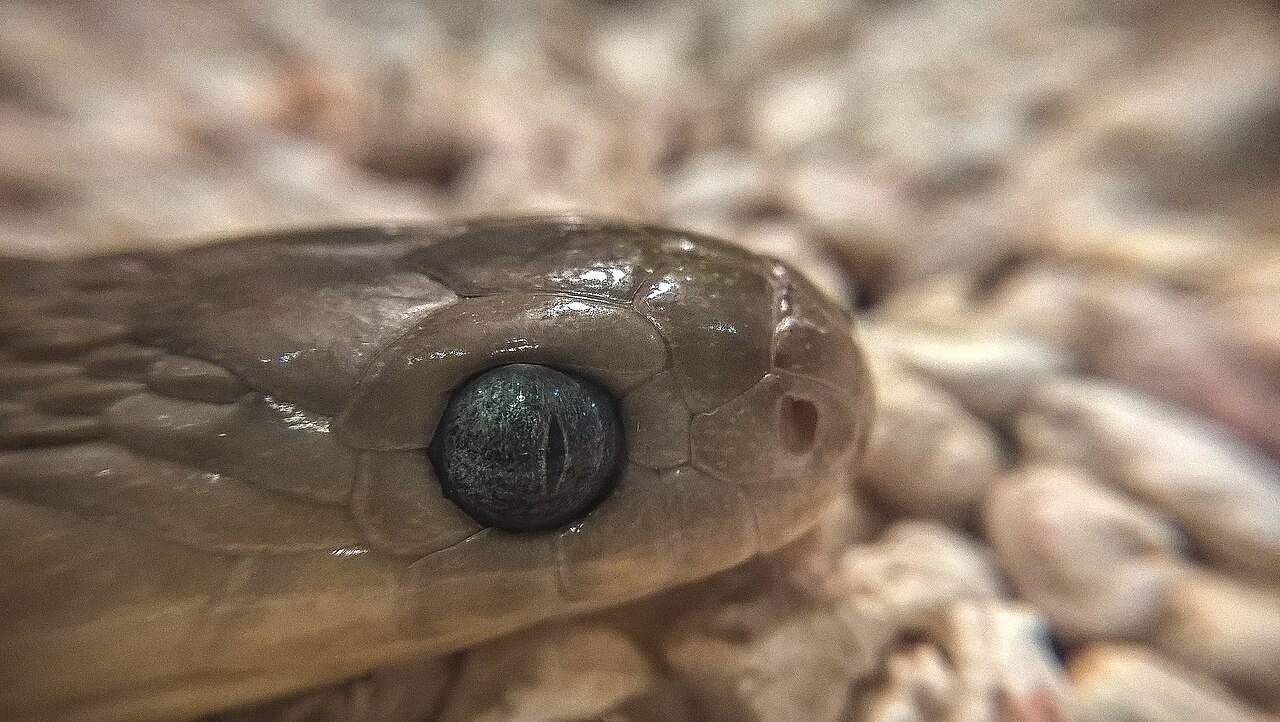
People ask whether snakes cry for two different reasons. Some want to know if a snake can produce tears the way a human or a dog does, and others wonder whether a snake might cry from pain, fear, or sadness. The short answer to both is no, at least not in any way you would recognize. Snakes do make fluid that keeps their eyes healthy, but their eye anatomy is built so that this fluid never runs down the face, and there is no scientific evidence that snakes shed tears as an emotional signal.
The key to understanding this is the spectacle, sometimes called the brille. Snakes have no movable eyelids. Over evolutionary time the lids fused into a single transparent scale that covers each eye like a built-in contact lens. That is why snakes never blink and why their stare looks so fixed. The spectacle protects the eye from dust, scratches, and prey that fights back, and it is replaced every time the snake sheds its skin. Because the eye is sealed under this scale, there is simply no open edge for tears to spill over.
Under the spectacle, between it and the surface of the eye, is a thin fluid-filled space. Most of that fluid comes from the Harderian gland, which sits behind the eye and is relatively large in snakes. The fluid bathes and lubricates the eye, then drains through a narrow duct, the nasolacrimal duct, into the roof of the mouth. In other words, a snake's tear system works continuously, but the output goes inward rather than outward. Some researchers have suggested this drainage may connect to the snake's chemical senses because it empties near the openings of the vomeronasal organ, though that idea is still being studied and should not be overstated.
Several things can make a snake look as if it is crying, and they are worth knowing so you do not misread what you see. A snake that has just crossed wet grass, soaked in a puddle, or been caught in rain can have droplets beading on its head and around the eyes. A snake approaching a shed often has cloudy, milky blue eyes because fluid builds up between the old and new layers of skin, and that dull, glassy look can be mistaken for something emotional or for illness. In captive snakes, a blocked drainage duct or a retained old spectacle can cause fluid to pool and the eye to bulge, which is a veterinary problem, not crying. None of these involve tears falling from the eye.
Folklore adds a few more confusions. The phrase crocodile tears refers to crocodilians, not snakes, and even there it describes fluid that has nothing to do with sorrow. Some people also believe spitting cobras spray venom from their eyes. They do not. Spitting cobras force venom out through small forward-facing openings at the tips of their fangs and aim it toward a threat's face, which is exactly why anyone in regions with spitting cobras, such as parts of India and Africa, should keep well back. As for emotions, snakes clearly have stress and defensive responses, but there is no established evidence that they experience sadness or express it through tears. A hissing, coiled, or flattened snake is communicating that it feels threatened and wants space, not that it is upset in a human sense.
The useful takeaway is that a snake's eyes can still tell you something, as long as you look from a safe distance. Cloudy eyes often mean a shed is coming, and snakes in that stage can see poorly and may be more defensive than usual. Wet-looking scales usually mean recent contact with water. Eye position, pupil shape, and the scales around the eye can be part of identification, but they are never reliable enough on their own to decide whether a snake is safe, and getting close enough to study them is how bites happen.
If you spot a snake and want to know what it is, stay at least a couple of body lengths away, more for any snake you cannot identify, and take a clear photo with your phone's zoom rather than stepping closer. SerpentID can compare the head, eyes, body pattern, and markings against the species most likely to occur where you are. Never try to handle, corner, or kill the snake. If it turns out to be venomous or it is somewhere you cannot safely leave it, contact your local wildlife service or a licensed snake removal professional, and if anyone is bitten, seek professional medical help immediately.