


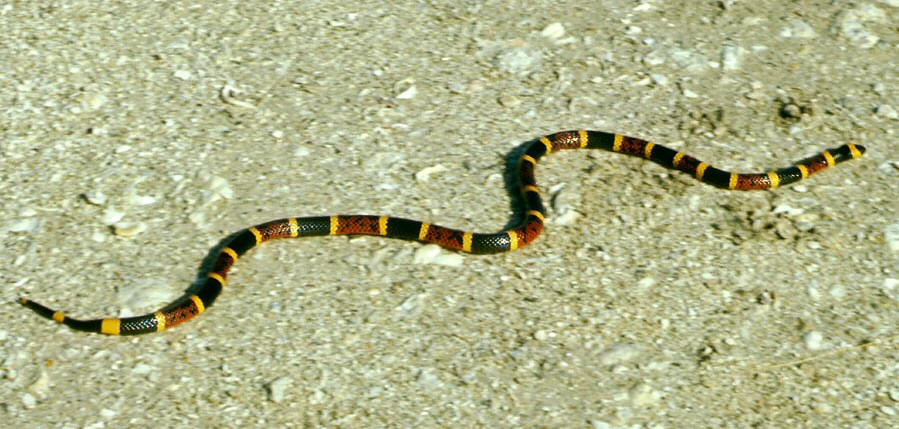
One of the most searched snake questions is coral snake vs kingsnake, usually because both can show bold red, black, and yellow or cream bands. The problem is that shortcut rhymes compress a real identification problem into a memory trick that can fail outside specific regions.
A safer comparison starts with full-band order across multiple parts of the body, not one partial section. Mud, shadow, motion blur, and damaged scales can scramble the apparent sequence and make a confident guess look easier than it is.
Geography matters. Different nonvenomous mimics appear in different states, and their band colors are not always identical to the version people remember from a rhyme. If you do not know the likely species in your area, the rhyme becomes even weaker as a decision tool.
Coral snakes also tend to look cleanly banded and glossy in good light, but field photos are rarely perfect. That is why SerpentID should be used as a comparison aid rather than a reason to get closer for one more angle.
If the app suggests coral snake, or if the photo quality is poor and the stripe pattern remains unresolved, treat the encounter as potentially dangerous. From a safety standpoint, that conservative call is better than over-trusting a memory rule built for ideal conditions.