


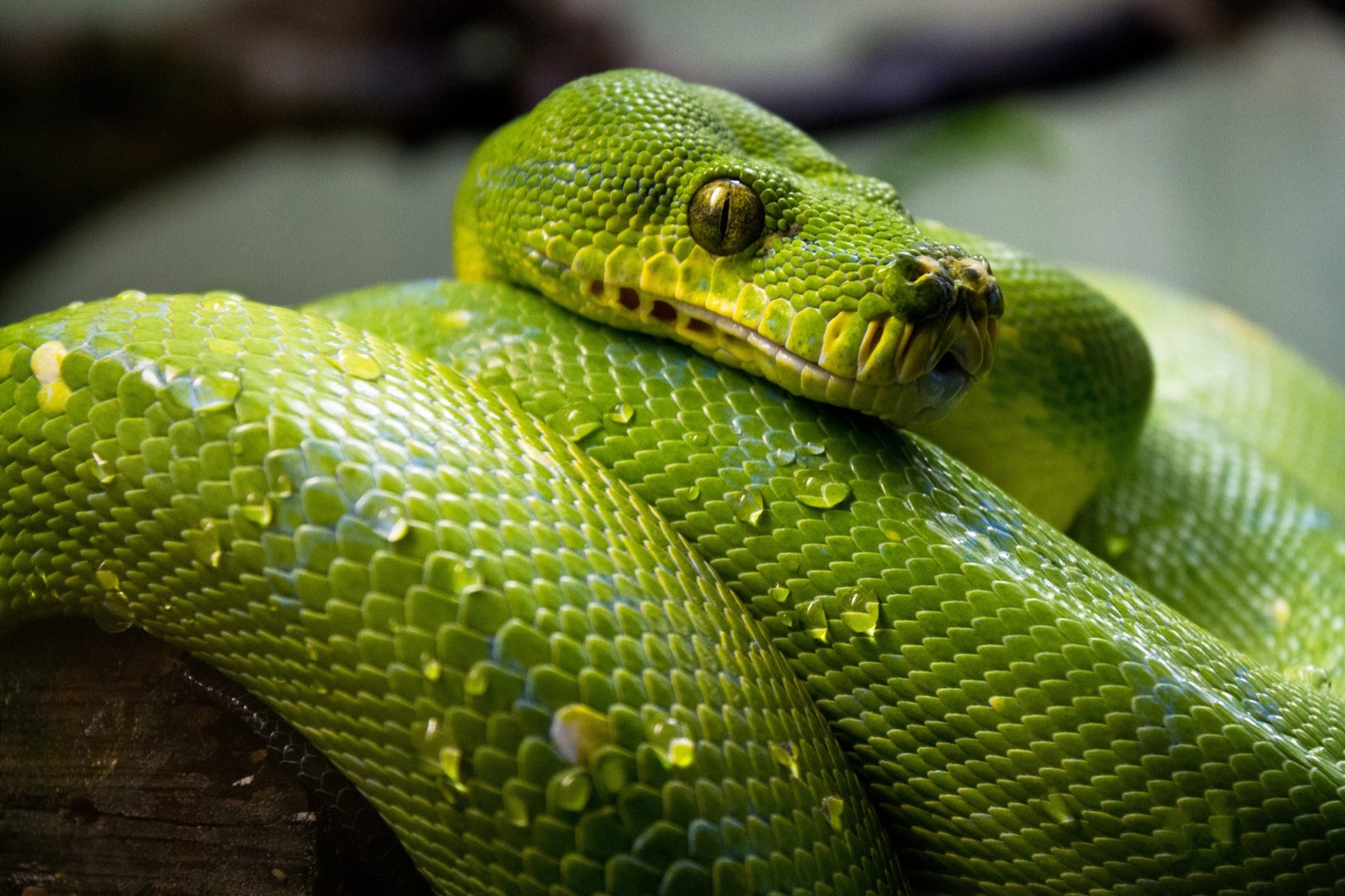
The short answer is no, snakes cannot fly in the way birds, bats, or insects do. No snake flaps, hovers, or gains height under its own power. But the question is not as silly as it sounds, because a handful of snake species really do travel through the air. These are the so-called flying snakes of the genus Chrysopelea, a group of roughly five slender tree snakes found across South and Southeast Asia. What they do is gliding: a controlled descent that carries them much farther horizontally than a simple fall would. Herpetologists and engineers have studied them closely, and the more we learn, the more remarkable the behavior turns out to be.
A glide usually begins high in a tree. The snake moves out toward the end of a branch, lets the front part of its body hang down in a J-shaped loop, and then thrusts itself upward and outward, pushing off with the rest of its body. Once airborne, it does something no other snake does: it spreads its ribs forward and outward, flattening its body to roughly twice its normal width. In cross-section the body becomes a shallow, slightly concave shape, which lets it generate lift as air flows past. Instead of dropping straight down like a rope, the snake begins to sail forward on a downward-sloping path.
The strangest part is what happens next. Flying snakes do not hold still in the air. They undulate in broad side-to-side waves, much as they would when crawling on the ground, while also moving parts of the body up and down. For years researchers wondered whether this was just leftover habit or something useful. Studies led by Jake Socha at Virginia Tech, including high-speed motion capture and computer modeling published in 2020, showed that the undulation helps stabilize the glide; without it, simulated snakes tended to tumble. The snakes can also bank and change direction in midair, which helps them reach a chosen landing spot on another tree or on the ground.
How far can they go? Field measurements generally record glides on the order of 10 to 25 meters from moderate launch heights, and longer glides are possible from taller trees. You will sometimes see claims of snakes gliding a hundred meters or more, but those figures are not well supported, so it is safest to say that flying snakes can cover tens of meters in a single glide. That is enough to cross gaps in the forest canopy, escape a predator, or drop onto a new hunting area without the slow, exposed trip down one trunk and up another. Their diet reflects their arboreal lifestyle: they hunt mainly lizards such as geckos, along with frogs, and occasionally small birds or bats.
For readers in India, the most relevant species is the ornate flying snake, also called the golden tree snake, Chrysopelea ornata. It occurs in parts of India including the northeast, the east, and the Western Ghats region, and related species live in Sri Lanka and across Southeast Asia. Flying snakes are rear-fanged and have mild venom suited to subduing small prey. They are not considered medically significant to people, but that does not mean they should be handled; any snake can bite when grabbed or cornered, and anyone bitten by any snake should seek professional medical help immediately. In the United States and Australia there are no gliding snakes at all. Tree-climbing species such as rat snakes in North America or common tree snakes in Australia can occasionally drop or fall from branches, and that sometimes gets described as a snake jumping or flying, but it is not true gliding. Stories of snakes leaping at people from trees to attack them are folklore rather than established behavior.
Whether a snake is draped over a branch, resting in a hedge, or has just dropped onto a path, the safe approach is the same: stay back, give it room to move away, and never try to touch, catch, or kill it. If you want to know what you saw, take a photo from a safe distance and let SerpentID compare the markings, body shape, and pattern against the species most likely in your area, whether that is an ornate flying snake in India, a rat snake in the eastern United States, or a tree snake in Queensland. If the identification suggests a venomous species, or the snake is somewhere it poses a risk to people or pets, contact your local wildlife services or a licensed snake catcher and let them handle it.