


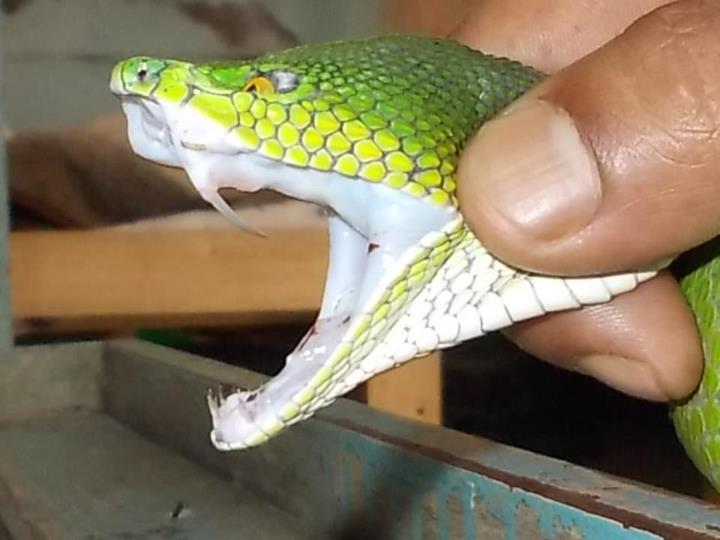
Yes, a decapitated snake can absolutely still bite. This startling fact often surprises people, but it's a crucial piece of information for anyone who might encounter a snake, especially a venomous one. The phenomenon isn't a sign that the snake is "alive" in any conscious sense, but rather a display of powerful, involuntary muscle reflexes. Even after its head has been severed from its body, the snake's nervous system retains residual energy that can trigger muscular contractions, including the snapping shut of its jaws and the deployment of its fangs.
This post-mortem activity stems from the snake's relatively simple nervous system. Unlike mammals, which rely heavily on a centralized brain for most functions, snakes and other reptiles have a more distributed nervous system. Peripheral nerves throughout the body can still respond to stimuli for a period after the brain has ceased to function. These residual electrical impulses can cause muscles to contract, leading to movements like coiling, twitching, and, most critically, biting. It's similar to how a chicken might run headless for a short time, or how a frog's leg can twitch when stimulated after being removed from the body.
The duration of these reflexes can be surprisingly long, sometimes lasting for several hours, particularly in cooler temperatures that slow down cellular degradation. The head itself, if separated, can also exhibit biting reflexes. If poked or prodded, the jaws can still open and close with considerable force. This means that a seemingly "dead" snake head can still pose a significant threat, capable of delivering a full venomous bite if its fangs are intact and its venom glands are functional.
For venomous snakes, the danger is compounded by the fact that the venom glands remain fully capable of injecting venom. The act of biting, even if purely a reflex, can still deliver a potent dose of neurotoxins, hemotoxins, or cytotoxins. There is no "off switch" for the venom delivery system immediately upon death. Therefore, attempting to decapitate a venomous snake, or handling a recently decapitated one, creates an extremely hazardous situation where a severe envenomation is a very real possibility. This is why wildlife experts strongly advise against attempting to kill or handle any snake, dead or alive.
The impulse to kill a snake, often out of fear or a misguided sense of protecting others, is common. Decapitation is sometimes seen as a definitive way to neutralize the threat. However, this action often puts individuals at greater risk. Not only does it expose a person to the snake's defensive capabilities during the act itself, but it also leaves behind a potentially dangerous, disembodied head that can still bite. Furthermore, the body might continue to writhe, making cleanup difficult and dangerous.
It's important to understand that these post-mortem movements are not a sign of the snake suffering or "coming back to life." They are purely physiological responses, devoid of consciousness or intent. Debunking the myth that a snake can "live on" after decapitation helps to underscore the true nature of the danger: it's not a zombie snake, but rather a physical mechanism that still functions. This scientific understanding reinforces the need for extreme caution and respect when dealing with any snake, regardless of its apparent state.
The safest approach when encountering any snake, whether it appears alive or dead, is to maintain a significant distance. Never attempt to approach, handle, or kill a snake. If you find a snake in your yard or home and are concerned about its presence, the best course of action is to take a clear photograph from a safe distance. Then, use an identification app like SerpentID to compare its markings against local species. If it's identified as venomous, or if you're unsure, contact local animal control or a professional wildlife removal service immediately. Their expertise ensures the snake is handled safely and humanely, protecting both the animal and yourself.