


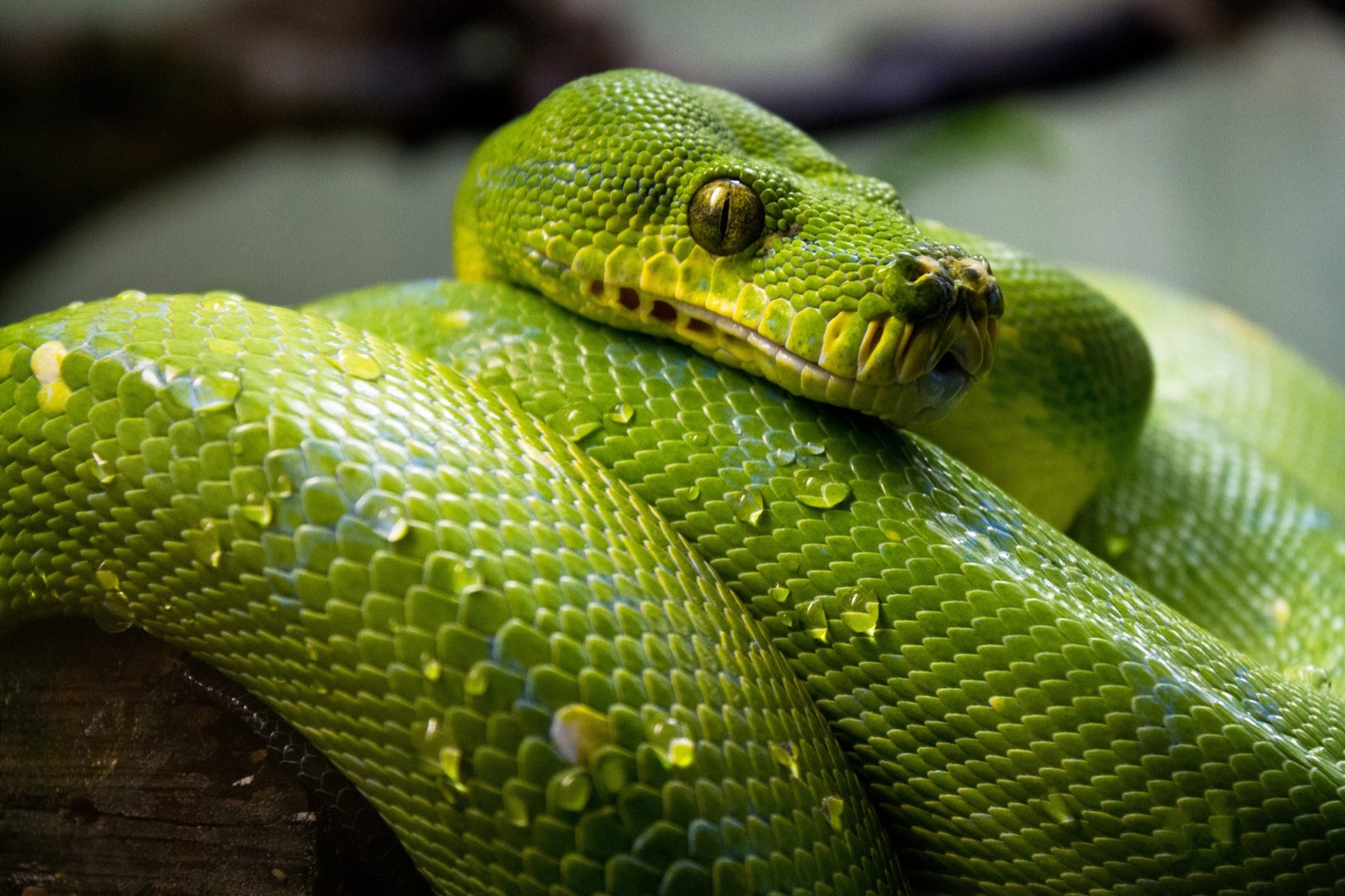
Boa vs python is one of the most common questions people ask about large snakes. The confusion makes sense. Both groups are heavy-bodied, nonvenomous snakes that kill prey by constriction. Both have small spurs near the vent, which are remnants of hind limbs from distant legged ancestors. Both include some of the largest snakes on Earth. But herpetologists place them in separate families: Boidae for the boas and Pythonidae for the pythons. Many of their similarities are a result of convergent evolution. Two lineages faced similar ways of life and arrived at similar body plans. The best example is the green tree python of New Guinea and northern Australia. It looks almost identical to the emerald tree boa of South America. Both are bright green, both live in trees, and both rest in neat coils draped over a branch, yet they are only distantly related.
The most reliable everyday difference is how they reproduce. Pythons lay eggs. Females of many species coil around the clutch to protect it. A few, such as the Burmese python and the Indian rock python, can even twitch their muscles to raise the temperature of the eggs. Boas are almost all live-bearers, giving birth to fully formed young, with only a handful of exceptions. This trait doesn't help much when you meet a snake on a trail. It does explain why the two families are not simply big and small versions of the same animal. Their evolutionary histories run on separate tracks.
Geography is the most practical clue for most people. Pythons are an Old World group found in Africa, southern Asia, and Australia. Boas are concentrated in Central and South America and the Caribbean, with smaller groups in Madagascar and elsewhere. The famous giants follow this pattern. The green anaconda, the heaviest snake in the world, is a boa from South America. The reticulated python of Southeast Asia is generally considered the longest. Internal anatomy differs too. Pythons, for example, usually have teeth at the very front of the upper jaw where boas generally lack them, but that is a detail for specialists, not something to check in the field. Heat-sensing pits are also not a dependable shortcut. Many pythons have obvious pits in the lip scales and some boas have them as well, while others in each family have none.
Readers in each of our regions meet a different side of this story. In the United States, the only native boas are small, gentle species. The rubber boa lives in the West, and the rosy boa lives in the deserts of the Southwest. Pythons are not native anywhere in the country. In Florida, however, Burmese pythons released or escaped from the pet trade have become established in and around the Everglades, where they have caused serious declines in native mammals. Australia has no native boas at all. Its large constrictors are all pythons, including carpet pythons, the olive python, the black-headed python, the woma, and the scrub python of tropical Queensland. In India, the Indian rock python is the best-known species. The Burmese python occurs in the northeast, and the reticulated python is found in the Nicobar Islands. India also has boas: the small, stout sand boas.
India's sand boas show why shortcuts can mislead in both directions. The common sand boa has a blotched brown pattern and a thick body. Startled people sometimes mistake it for the highly dangerous Russell's viper, and that mistake has gotten many harmless sand boas killed. In the other direction, people sometimes assume a heavy, patterned snake must be a harmless constrictor when it is actually a viper. Sand boas also carry an old myth that they have two heads, because their blunt tail looks a lot like the head. They do not, of course. The red sand boa suffers from a different myth: false claims about its value have fueled illegal trafficking, and it is protected under Indian wildlife law.
Neither boas nor pythons are venomous, but that does not make them safe to approach. Large individuals have many sharp, backward-curving teeth and can deliver painful bites that tear the skin. The biggest species are powerful enough to be dangerous to people. Smaller boas and pythons will also bite if they are cornered or grabbed. Treat any wild constrictor the way you would treat any other snake. Give it space, keep children and pets back, and never try to pick it up or move it yourself. If anyone is bitten by any snake, seek professional medical help immediately. Don't rely on your own guess about the species, because misidentification is common even among confident observers.
If you come across a large, heavy-bodied snake and aren't sure whether it is a python, a boa, or something more dangerous, stay back. Take a clear photo from a safe distance. Try to capture the head, the body pattern, and the overall shape, then let SerpentID compare those markings against the species likely to occur where you are. This matters most in places like South Florida, northern Australia, and much of India. In those areas, a harmless constrictor and a venomous viper can share the same yards, fields, and roadsides. If the result points to a venomous species, or if the snake is very large and near homes or animals, contact your local wildlife service or a licensed snake rescuer. Let them handle it, rather than trying to handle it yourself.