


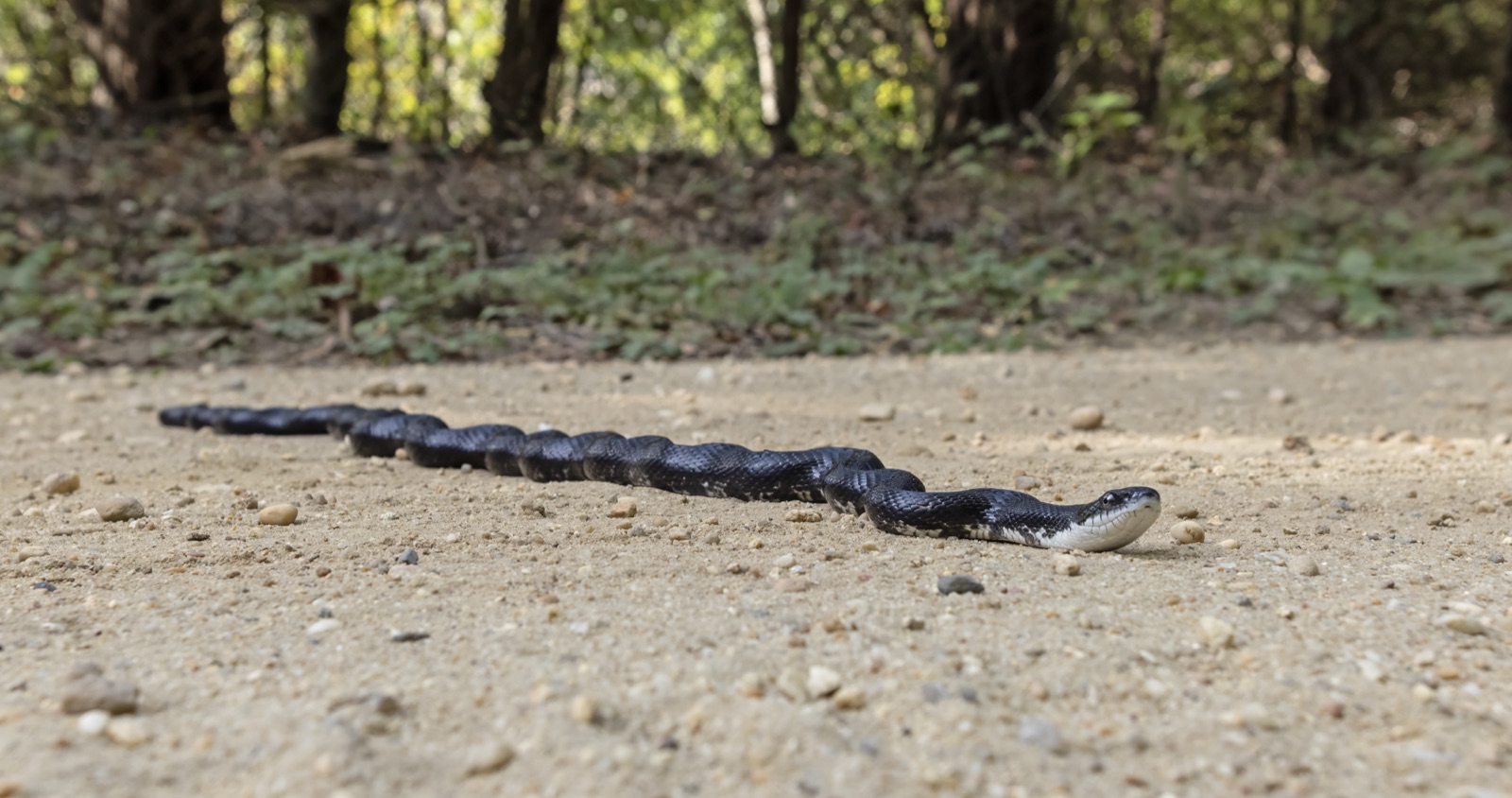
Rat snakes are not venomous. In North America the name usually refers to the Pantherophis group, which includes the eastern rat snake (often called the black rat snake), the gray or central rat snake, the Texas rat snake, and the Great Plains rat snake, a close relative of the corn snake. All of them are constrictors. They catch prey with their mouths, wrap coils around it, and squeeze until the animal's circulation fails. They have no hollow or grooved venom fangs and no venom delivery system of medical concern, which places them firmly among the harmless snakes a homeowner is likely to meet.
That does not mean a rat snake will never bite. A rat snake that is grabbed, pinned, or cornered may strike repeatedly, and a large adult can be startlingly persistent about it. Their teeth are small, numerous, and curved backward to grip prey, so a bite typically leaves a horseshoe of shallow scratches or punctures rather than two distinct fang marks. Even so, bite-mark patterns are not a reliable way for a frightened person to judge which snake was involved. If you or anyone else is bitten by a snake you cannot confidently identify, seek professional medical help immediately rather than trying to decide on your own whether it was dangerous.
Much of the confusion around rat snakes comes from their defensive behavior. When threatened, many rat snakes freeze in a kinked, zigzag posture that makes them look rigid and coiled. They may vibrate the tip of the tail, and in dry leaves that buzz can sound surprisingly like a rattle. They can flatten the head slightly, release a strong-smelling musk, and strike from a raised position. None of these displays indicates venom. They are bluffs and warnings from an animal that would much rather be left alone, and they are a good reason to give any snake plenty of space instead of testing its patience.
Young rat snakes cause the most identification mistakes. Hatchlings and juveniles of the eastern and gray rat snakes are pale gray or tan with dark brown blotches running down the back, a pattern that many people read as a copperhead or even a small rattlesnake. Adult eastern rat snakes, by contrast, often turn nearly solid glossy black, sometimes with faint traces of the juvenile blotches and a white or checkered belly. Head shape is not a dependable shortcut either, because a defensive rat snake can widen its jaw area. Body proportions, pattern details, scale texture, and habitat together give a far better picture than any single feature.
Rat snakes are also the subject of several stubborn myths. The so-called pilot black snake is said to lead copperheads or rattlesnakes to their dens, and some people believe rat snakes interbreed with copperheads to produce dangerous hybrids. Neither claim holds up. Rat snakes and copperheads belong to entirely different families, and while different species sometimes share winter dens, that is a matter of good shelter, not partnership. It is also not true that keeping rat snakes around guarantees no venomous snakes nearby. What rat snakes reliably do is eat rodents, along with birds, eggs, and occasionally other small animals, which is why they turn up around barns, chicken coops, attics, and woodpiles.
Readers outside the United States may meet a similar name. In India, the Indian rat snake or dhaman (Ptyas mucosa) is a large, fast, nonvenomous species that is frequently mistaken for a spectacled cobra, especially when it rears up or moves quickly through fields and around homes. Australia has no native rat snakes, but it does have plenty of harmless pythons and colubrids that are routinely confused with dangerous elapids. In every region the lesson is the same: a common name tells you less than careful observation, and the safest default is to treat any unidentified snake as potentially dangerous until you know otherwise.
If you find a long dark snake on a fence, a blotchy young snake in the mulch, or a climber tucked into the rafters of a shed, resist the urge to step closer, poke it, or try to move it. Take a clear photo from a safe distance, ideally showing the head, the full body, and the pattern, and let SerpentID compare those markings against the rat snakes and look-alikes that actually occur in your area. If the result points to a venomous species, or the snake is inside your home and you are not sure what it is, contact your local wildlife service or a licensed snake catcher and keep people and pets well away until help arrives.