


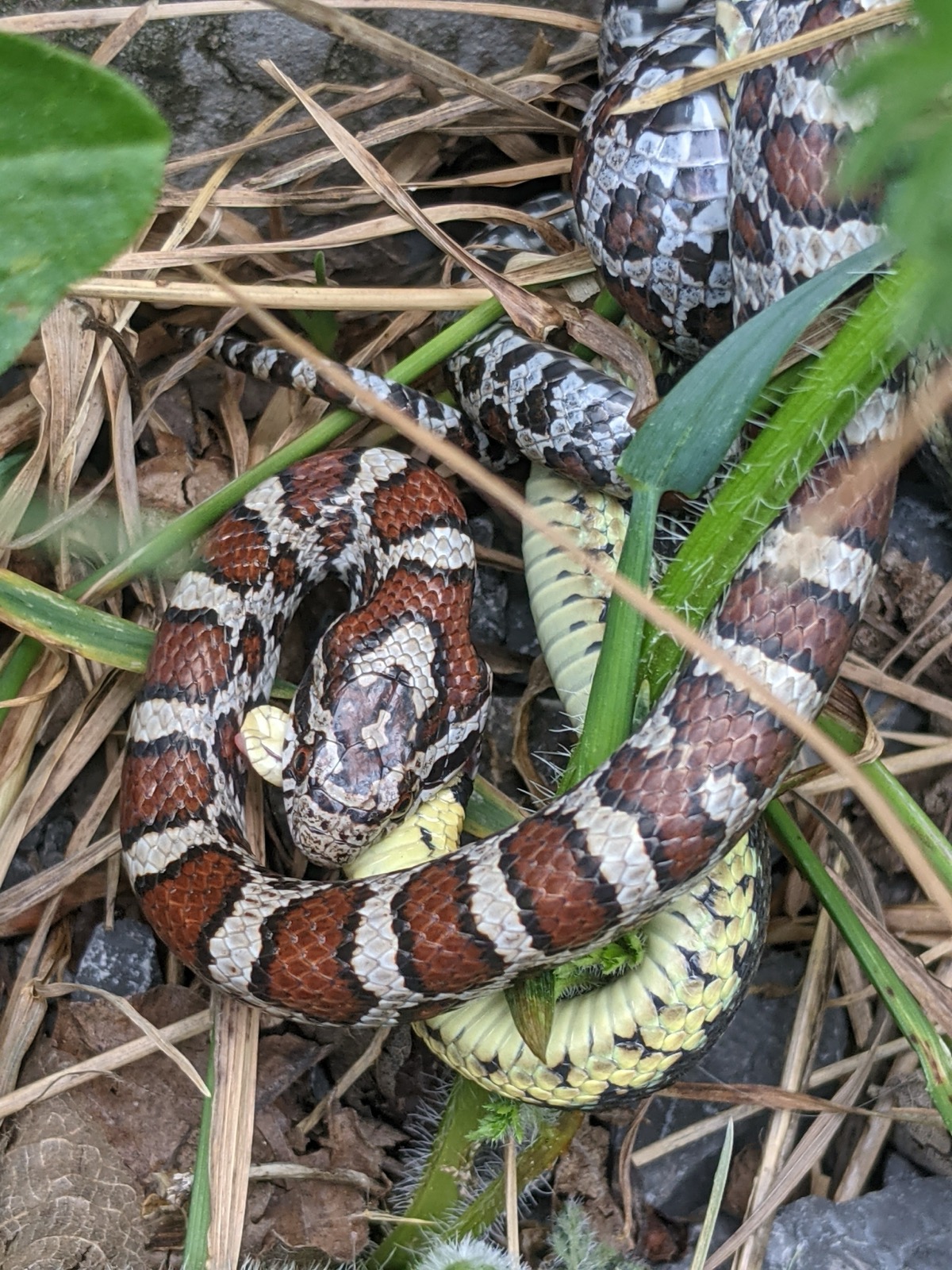
Milk snakes are not venomous. They have no fangs and no venom glands. They kill their prey by constriction, wrapping coils around a mouse or small snake until it can no longer breathe or circulate blood. In North America, milk snakes belong to the genus Lampropeltis, the same group as kingsnakes. Like their kingsnake relatives, they will eat other snakes, including small venomous ones. A milk snake turning up in a woodpile or basement is not a threat to anyone who gives it space. What makes it worth learning about is how often people confuse it with something dangerous.
The name comes from an old rural myth. Milk snakes were often seen in barns and dairy sheds, and farmers once believed they crept up and drank milk straight from cows. They do not, and they cannot. Snakes have no way to suckle, and adults cannot digest milk. The real reason milk snakes hang around barns is mice. Grain, hay, and feed draw rodents, and rodents draw the snakes that hunt them. The same logic explains why milk snakes are so often found in stone foundations, basements, and old outbuildings. Those cool, sheltered spaces also make good places to spend the winter.
Milk snakes were long treated as a single wide-ranging species, Lampropeltis triangulum. That species was thought to stretch from southeastern Canada through much of the United States and into Central and South America. Genetic studies in the last decade have split it into several species, though field guides still use the common name broadly. In the eastern US and Canada, the form people usually meet is the eastern milk snake. Adults are typically 60 to 90 centimeters (about 2 to 3 feet) long. The body is gray to tan with rows of reddish-brown or chestnut blotches, each outlined in black. Many have a pale Y- or V-shaped mark at the back of the head. The belly often looks like a black-and-white checkerboard. Farther south and west, milk snakes are more brightly banded in red, black, and yellow or white. That banding is where the coral snake confusion begins.
The most common mix-up in eastern yards is with the copperhead, and a few features help separate them. A copperhead's bands are shaped like an hourglass, wide on the sides and pinched narrow along the spine. A milk snake's blotches do the opposite: they are widest across the back, like saddles, and sharply edged in black. Copperheads have a plain, unmarked coppery head. A milk snake's head usually carries some pattern, often that neck blotch or Y-mark. Milk snakes also have smooth, glossy scales that can look almost polished. Copperheads have keeled scales with a slightly rough, matte look. Copperheads also have vertical pupils and heat-sensing pits between eye and nostril. Treat those as confirmation clues, not reasons to lean in closer. If you cannot see a feature clearly from where you stand, that feature cannot help you decide.
The banded milk snakes of the South and West are classic coral snake look-alikes. In the United States, the rhyme 'red touches yellow, kills a fellow; red touches black, friend of Jack' usually holds. On a coral snake, the red and yellow bands touch. On most milk snakes and scarlet kingsnakes, black bands separate red from yellow or white. The rhyme has real limits, though. It does not work reliably in Mexico, Central America, or South America, where coral snakes vary much more. Faded, abnormal, or juvenile patterns can also make the bands hard to read, especially in low light or a blurry glimpse. The safer approach is to treat any brightly banded snake as potentially dangerous until you have a clear identification.
Milk snakes are secretive and spend most of their time under boards, rocks, and leaf litter, often moving at dusk or night in warm weather. When cornered, a milk snake may coil, hiss, strike, and rapidly vibrate its tail. In dry leaves, that buzzing can sound a lot like a rattlesnake. It may also release a foul-smelling musk. This is bluffing from an animal that would rather escape. A milk snake can bite if someone grabs it, but the bite carries no venom. That said, never handle, corner, or try to kill any snake. Most bites happen during exactly those attempts. If you are ever bitten by a snake you have not positively identified, seek professional medical help immediately rather than guessing.
If you find a blotched or banded snake in your basement, barn, or garden, start by keeping people and pets back. Then take a clear photo from a safe distance, ideally showing the head, the shape of the blotches or bands, and a stretch of the body. SerpentID can compare those markings against the milk snakes, copperheads, coral snakes, and other species likely in your area, so you are not relying on a rhyme or a quick glance. If the result suggests a venomous species, or you remain unsure, contact your local wildlife services or a licensed snake removal professional. They can move the animal safely. If it turns out to be a milk snake, you can usually just let it go on its way and keep hunting your mice.