


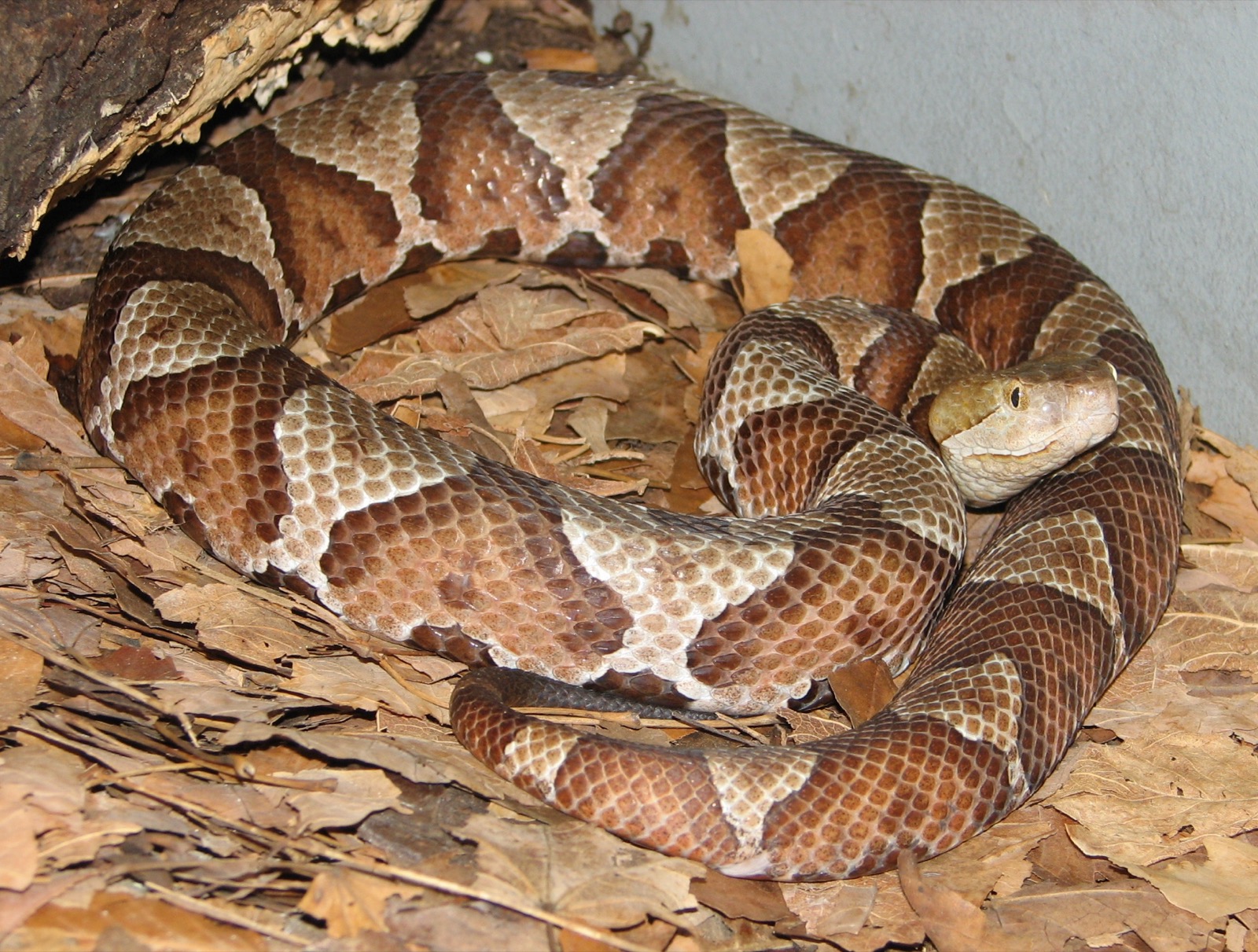
Copperheads have a reputation as mean, hot-tempered snakes, and it is easy to see why. In much of the eastern and central United States, from southern New England down to northern Florida and west into Texas, Oklahoma, and Kansas, they cause a large share of venomous snakebites. But a high bite count does not mean the snake is aggressive. In herpetology, aggression toward people is not a meaningful description of what copperheads do. They are defensive animals that would much rather go unnoticed, and almost every bite traces back to a person getting very close without realizing a snake was there.
The key to understanding copperhead behavior is camouflage. Their coppery, tan, and chestnut bodies are crossed by darker hourglass-shaped bands, often described as looking like Hershey's Kisses when seen from the side. Against fallen leaves, mulch, pine straw, or a woodpile, that pattern breaks up the snake's outline almost perfectly. A copperhead's first line of defense is to stay still and trust that disguise. Where a racer or a garter snake might bolt away, a copperhead often holds its ground, sometimes for a long time, even as footsteps come closer.
That freeze response is exactly what leads to bites. A gardener reaches into a flower bed, a homeowner picks up a board, a hiker steps over a log, or someone walks barefoot across a lawn at night during the warm months, when copperheads are often active after dark. The snake has been relying on staying hidden, and suddenly a hand or foot is on top of it. A bite in that moment is a last-resort defense, not an attack. Field studies of copperheads approached by researchers have found that they usually remain motionless or try to move away when left alone, and that bites tend to happen only when they are touched, pinned, or stepped on.
Copperheads also give signals before biting when they have the chance. A disturbed copperhead may pull into a loose coil, raise the front of its body into an S-shape, vibrate its tail rapidly against dry leaves to produce a buzzing sound, or release a strong-smelling musk. These are warnings that say back off. A common myth holds that copperheads chase people or strike from far away; neither is true. A copperhead's strike reaches only a portion of its body length, and an adult is typically around two to three feet long. Simply stepping back several feet and leaving the snake alone almost always ends the encounter.
None of this means a copperhead bite should be taken lightly. Copperhead venom is generally considered less potent than that of many rattlesnakes, and deaths are extremely rare, but bites can cause severe pain, swelling, and tissue damage, and every bite needs to be treated as a medical emergency. If anyone is bitten, seek professional medical help immediately. It is also worth knowing that juvenile copperheads are venomous from birth and carry a bright yellow or greenish tail tip they use to lure prey, so a small size is never a reason to relax. Readers in Australia should note that the snakes called copperheads there belong to an entirely different group, Austrelaps, which are elapids related to cobras and taipans; they are also shy and tend to avoid people, but their bites are dangerous and need urgent medical care.
The practical takeaway is that copperhead safety is about awareness rather than fear. Wear closed shoes outdoors, use a flashlight on paths and porches on warm nights, look before reaching into leaf piles, firewood, or dense ground cover, and wear gloves for yard work. Never try to kill, catch, or move a copperhead; a large proportion of bites happen to people attempting exactly that. Given space, a copperhead will usually stay put or slip away on its own, and many perfectly harmless snakes, such as corn snakes, milk snakes, water snakes, and young rat snakes, are mistaken for copperheads and killed needlessly.
If you spot a banded, copper-colored snake and are not sure what it is, stay back and take a photo from a safe distance rather than moving closer for a better look. SerpentID can compare the markings, head shape, and body pattern in your photo against the species most likely to occur where you live, helping you tell a copperhead from a harmless look-alike. If the snake turns out to be venomous and is in a spot where people or pets are likely to encounter it, contact your local wildlife services or a licensed snake removal professional and let them handle it.