


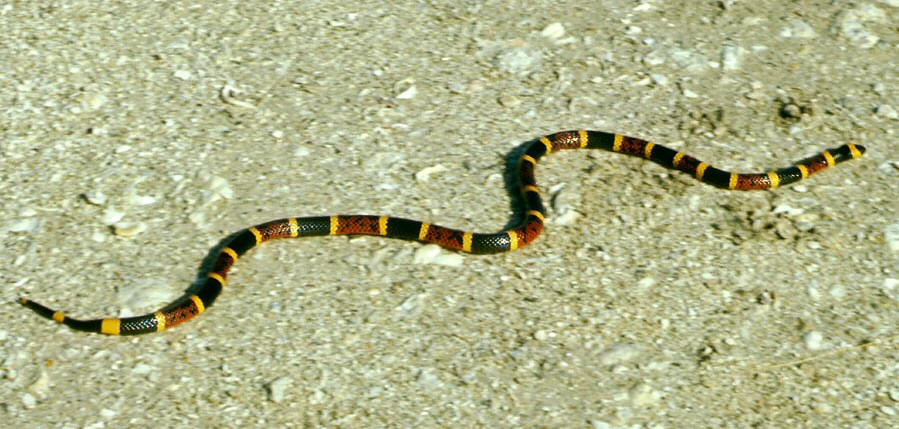
Scarlet snake vs coral snake is a careful southeast comparison because both snakes wear red, black, and yellow or white bands on a slim body, both stay small and secretive in pine flatwoods, leaf litter, and suburban mulch beds, and both can show up in the same garden bed at the same time of year. The old rhyme "red touches yellow, kill a fellow; red touches black, friend of Jack" is a useful first filter for U.S. populations, but the rhyme does not apply outside the United States and is not a substitute for a calm second look from a step back before reaching toward the animal.
Coral snakes (genus Micrurus) in the southeastern U.S. show wide red and black bands separated by narrow yellow rings that touch the red, a fully black snout that ends just behind the eyes, a small rounded head that is barely wider than the neck, and round pupils. The body looks like enameled rings wrapped tightly around a thin tube, and movement tends to be smooth and steady through leaf litter rather than fast retreats across open ground. Coral snakes are venomous and require medical attention for any confirmed bite.
Scarlet snakes (Cemophora coccinea) and scarlet kingsnakes (Lampropeltis elapsoides) share the red, black, and yellow palette but show red bands bordered by black on each side so the red never touches yellow, a red or mostly red snout instead of a black snout, and a head that blends smoothly into the neck. Scarlet snakes often have red saddles on a pale belly rather than full rings around the body, while scarlet kingsnakes wrap full rings like the coral snake and are the most common mimic that triggers a closer inspection.
Scarlet snake vs coral snake field clues stack: check the snout color first because a fully black snout strongly points to a coral snake, then check whether red touches yellow or red touches black, then check whether the belly carries full rings or red saddles. If the animal is curled under a board, partly hidden in mulch, or moving slowly through leaf litter without flattening or rattling, treat the ID as unconfirmed and back away rather than rolling the cover board for a clearer angle.
SerpentID can help compare band order, snout color, and head shape from a photo taken at a safe distance, but coral-snake-range encounters should stay conservative because the consequence of a wrong call is high. If the app suggests a venomous possibility, the snake slips into a burrow before the head is visible, or you find the animal where children play, contact local wildlife help and keep the area clear. Afterward, keep mulch beds thin near play areas, store wood and board piles off the ground on a frame, seal gaps under sheds and porches, and review your local coral-snake range map so the next sighting starts with the right baseline expectation.